Oh, the periphery (they throw good parties there)
Brief thoughts on letting go of the centre's hold
And if he finds himself yearning
For his throne on the silly side
Nothing wrong as long as he's learning
Going for a walk under the lovely blue sky, trying to wrap my head around the various deadlines I have coming up and how to navigate the flow of time, this fabulous song of Fiona Apple's arrived in my ears with a crunch.
Not for the first time, it got me thinking about what it might mean to embrace being on the periphery. If we accept that "the centre cannot hold", what might it mean to let go of its hold on us? To prise its fingers from their grip around our hearts?
Oh, the periphery
They throw good parties there
Whenever I talk about ideas and practices of grassroots, collective action, people almost always ask me some form of "ok, so how do we get governments and corporations to make that happen"?
I'm getting a bit better and bolder at saying "we don't".
The conviction that the only way change happens is through centralised forms of power is extraordinarily powerful in modernity. It's hegemonic.
And it's wrong.
And the funny thing is, the more obviously wrong it becomes, the stronger its hold on us gets. The clearer it becomes that centralised forms of power have neither the interest nor the capacity to make change, the harder we cling to the idea that we simply have no choice but to make them do so.
As Hannah Arendt put it:
"The end of a tradition does not necessarily mean that traditional concepts have lost their power over the minds of men. On the contrary, it sometimes seems that this power of well-worn notions and categories becomes more tyrannical as the tradition loses its living force and as the memory of its beginning recedes; it may even reveal its full coercive force only after its end has come and men no longer even rebel against it." (Between Past and Future, p26)
Change happens from the periphery.
Think of a flock of birds, or a school of fish, or a swarm of bees.
Tragically, today, most of us have to think of it through David Attenborough's eyes rather than our own. But we can still picture it, can't we? Shifting and swirling, changing direction as if by magic, as if directed by a single will.
It's not a single will that moves them. Nor even a common will. It's impulses from the edges - the periphery.
Those at the edges sense the conditions, and change direction based on what they sense. The body of the flock receives the impulses from the periphery. Either it responds and follows or it breaks apart and reforms.
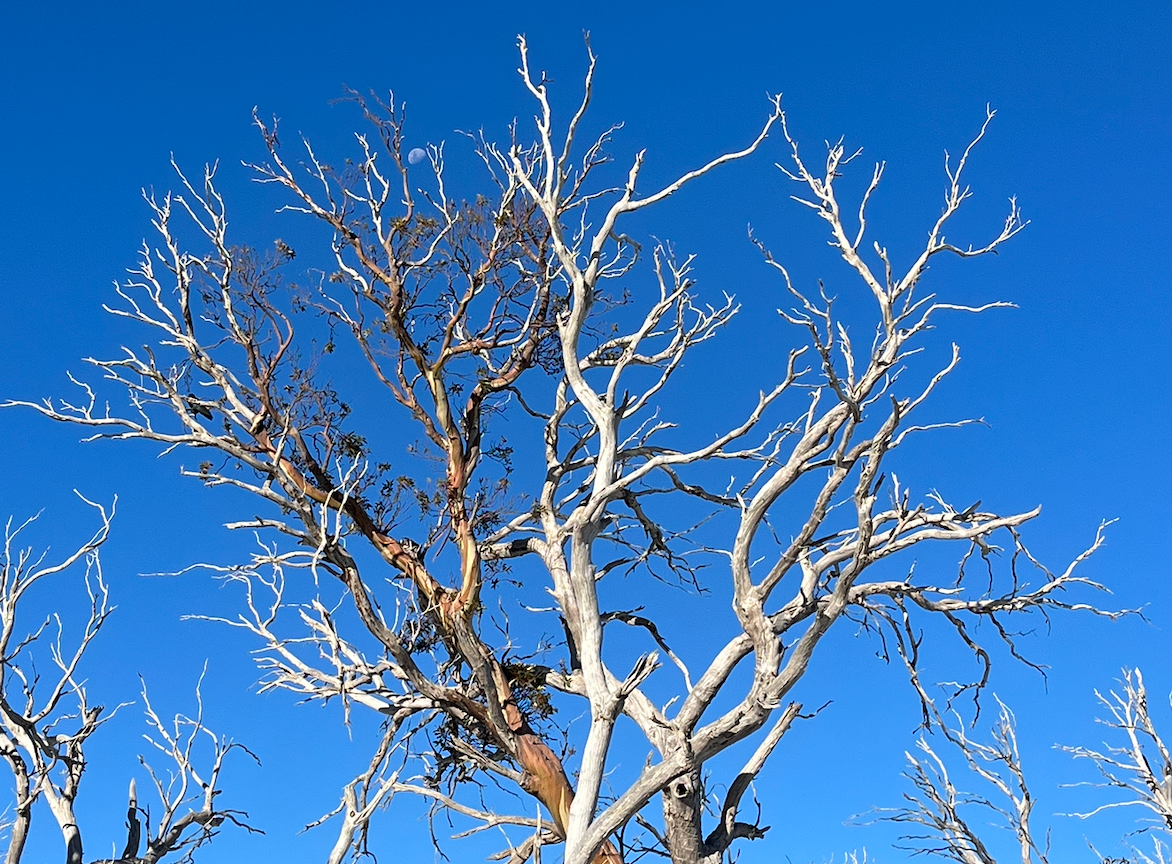
What about a tree? It can't move to seek nutrients. Instead, its roots, in symbiotic coexistence with mycelia, put out tendrils at the periphery to explore the soil. The brain of the tree, its nervous system, is dispersed around its farthest reaches. Instead of a central nervous system, we might call it a peripheral nervous system.
We humans, to the extent that we are ever individuals, think of ourselves as having a central nervous system. We like to think we direct oursleves from our brains. In fact, science is now telling us that we have as many neurons in our guts as we do in our brains, and we know we follow guidance from our fingertips and tongues and noses, often reacting faster than signals can get from there to our brains and back. But collectively we don't have a central nervous system at all. Societies have a peripheral nervous system.
Centralised power - the state, big corporations - tell us they are our brains, and we can only act through them. But they're not. And we can absolutely do more by going around them.
A brief thought, as much for my own benefit as a memory trigger as anything else, relating this to my thinking here and here on time and temporality and how it relates to our power and agency:
In the centre, acting through the state or the central nervous system, you have to think in terms of linear time. Actions have consequences. The past leads to the future. We must map out a clear, controllable pathway from now to then. We're told our only possible agency as individuals is through the centre, but we know we don't actually have any real power and agency that way.
At the periphery, we can learn instead how to become who we need to be for the times we are entering. At the edges, we can improvise, jam our way collectively into an emergent future.
The flock, the swarm, might follow. Or it might break apart and reform.
The central pull of Empire is waning. It's no fun there anymore.
What might happen at the periphery?
At least they throw good parties there.
Oh, the periphery
Oh, the periphery
Oh, the periphery
Oh, the periphery
Stay away
Stay away
Away, away
Stay away, away
Disclaimer: I don't think this is what this song means at all. I'm just following my thoughts down a rabbit hole 😜
PS: Between travel, events, actual academic writing deadlines, and season-change pain, my writing here may remain sporadic for a while. Apologies for that, if so. But it might mean a few more shorter pieces like this, rather than the longer, more thoroughly-thought-through stuff. Maybe that's better? More readable? Let me know your thoughts!