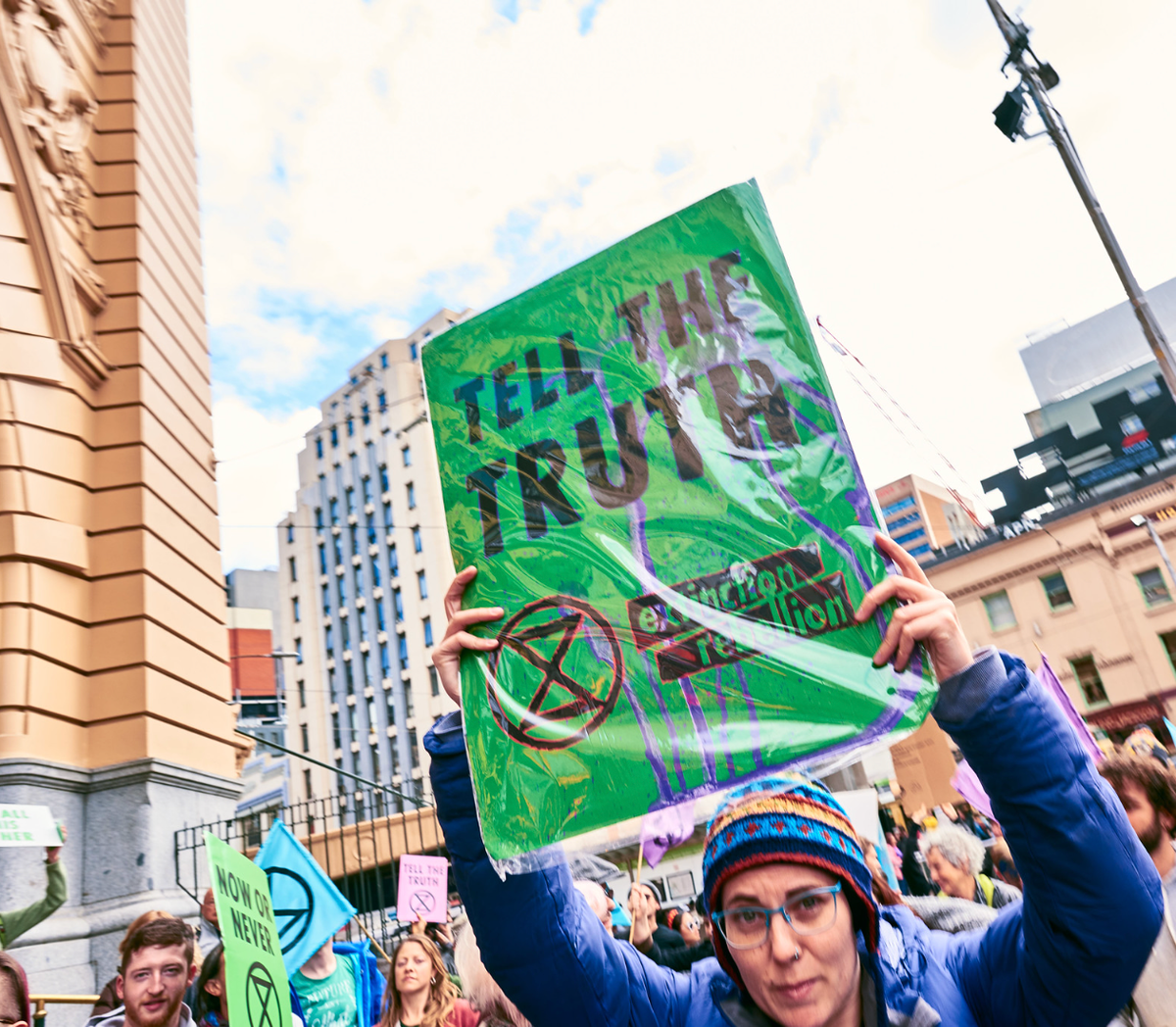
Telling the truth in politics? In this economy?

A post by Kos Samaras caught my eye this morning. It's been sitting with me all day and I thought I'd better quickly write something to get it out of my head.
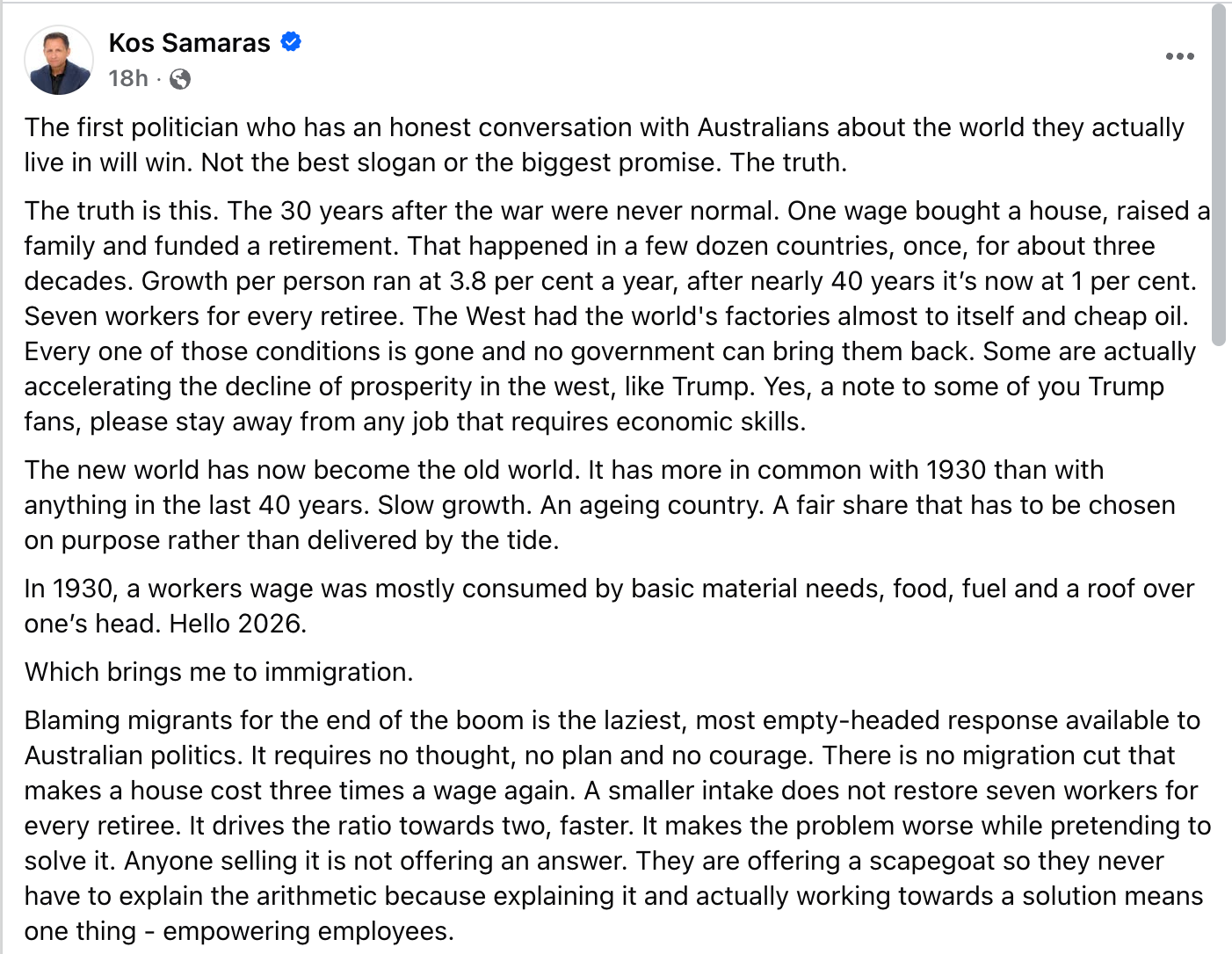
He wrote:
"The first politician who has an honest conversation with Australians about the world they actually live in will win. Not the best slogan or the biggest promise. The truth."
Wow.
I mean, yes! Thank you. Please. This is so important.
But, as I so often find with Samaras, he's onto something really insightful, informed by a genuinely deep understanding of where people are at, but he lets go of the insight before it takes him where it actually wants to go.
Here's the full post:
The picture at the top probably tells you what I'm about to say.
What Samaras writes here isn't not the truth. It's true, as far as it goes. And the conclusion about the scapegoating of immigrants as lazy politics is spot on. But it's not the whole truth.
The core of the problem is the one sentence in the post that I think is so partial in its truth to be effectively untrue:
"The new world has now become the old world."
There's a lovely line of Hannah Arendt's (because of course there is, there always is) where she talks about “The destructive distortions ... caused by men who had experienced something new which they tried almost instantaneously to overcome and resolve into something old.” (Between Past and Future, p29)
The new world has become the old world only in terms of this partial socio-economic analysis.
The record-breaking deadly floods in Istanbul are not the old world. The huge flash flood in Chile is not the old world. The torrential floods in Lima are not the old world. The disaster zone in Bangkok is not the old world. The record-smashing heat and fire in Europe is not the old world. The El Niño temperature anomalies Zeke Hausfather describes as "mind-blowing" are not the old world.
The "truth" is that the "world [we] actually live in" is unlike anything any humans have ever lived through before. The "truth" is that the cascading uncertainties of climate tipping points that are already being breached means none of us has any clue what the next few years will bring - beyond the general idea that it's going to be pretty chaotic.
And, um, that's only climate. We haven't even talked about the impact of LLMs and techno-fascist chat-bot politics.
This new world looks partly like the old world, but more like something completely new and unknown and unknowable.
It is impossible to genuinely resolve this new world into the old. Which is why most of us have our fingers in our ears, singing to ourselves. Or, like me, have a spoon literally in the honey jar, sucking on the sweetness for dear life.
I don't really blame Kos Samaras for not including this. Most particularly, I don't blame him because his work is to listen to and analyse what a wide cross-section of the Australian community is talking about, and I have no doubt that he hears very little about the climate crisis. The great hushing is very much upon us, as people do everything they can to not think about it.
But that is why we have to tell the truth. It's why we have to, as Arendt tells us "think what we are doing" (The Human Condition, p5) and "fac[e] up to, and resist... reality - whatever it may be" (Origins of Totalitarianism, p xviii).
And here's the really tricky bit.
Samaras, in his partial truth, concludes correctly that it's crucial to smack down the lazy non-solution of anti-immigrant politics, and acknowledge that there is no simple and easy answer. The hard truth is that life will be harder and the easy (for a given group of mostly white mostly men, to be clear) post-WWII world isn't coming back.
A harder truth is waiting for us in the climate reality.
If a politician were to truly have "an honest conversation with Australians about the world they actually live in", I think it has to go further. It has to recognise that the institutions and governing systems that created this crisis cannot solve them. It has to recognise that a set of institutions built for stable times cannot survive in this world of "turbulence", as David Schlosberg calls it. It has to embrace the cascading uncertainties, and do whatever it can to help prepare people and communities for what is coming.
At is very core, I think it needs to lead people, through both language and action, to the understanding that, in this world that is coming, if ever there was a time for us to learn how to be our best together, to learn the skills of good collective decision-making and mutual provisioning and care, that time is now.
Politics can promise us nothing. Its slogans will be washed away in the next flood of its lies, or burnt to ashes in the heat of its antagonisms.
But the truth might set us free of the expectations of politics and its slogans.
The truth, if we live it well, might actually help us survive together. And even thrive together, if we're lucky.