Zionism is ... a shibboleth

And, once again, material politics melts into air...
Argh.
I'm so unsurprised. But I'm still so disappointed.
Left populism, if not directed with great care and passion towards material campaigning, towards working on the ground to improve people's lives, swiftly gets caught up in performative politics, purity tests, and all sorts of self-defeating sugar-hit nonsense.
And so we see, with the sad decay of Zack Polanski's exciting project into this last weekend's foolish vote by the party's membership - a membership that has been guided only towards electoralism rather than community building and organising - to support a motion declaring that "Zionism is racism".
Zionism is a shibboleth - to use a wonderful Biblical word.
In the Bible story, soldiers of Gilead (hello, Margaret Atwood) demanded that people trying to flee across the River Jordan after a battle pronounce the word for an ear of corn. If they pronounced it "shibboleth", they were let through as members of the victorious tribe. If they pronounced it "sibboleth", they were presumed to be from the enemy tribe and they were executed.
A shibboleth is a test of whose side you're on. Literally.
That's what this motion is - it replaces material politics with a simplistic purity test. It replaces any attempt to construct mass politics across difference with in/out inanity.
Zionism is a difficult and fraught word.
I personally am not a Zionist. For me, diaspora, living with one foot in and one foot out, is the definition of my Jewish identity, bringing with it the powerful obligation of doykayt - "hereness": to make this place our home by doing our best to ensure that the place and its people are cared for, because only when all are safe will we be safe.
But many friends and family members who I love and respect and who are deeply deeply critical of not only the actions of the State of Israel but in many cases of its underpinnings, its founding, its place in the world, still identify with the word Zionism. For them, it simply connotes the right of Jewish self-determination - a right which, in the face of recurrent antisemitism, feels necessary. Attacking the word attacks their identity, and risks forcing them back towards it.
Of course, statist Zionism has done its best to erase the complexity of this meaning (something Hannah Arendt powerfully critiqued in her remarkable 1948 essay, To Save The Jewish Homeland). But that does not mean that those seeking Palestinian liberation should do its work!
And, also of course, statist Zionism has sought to defend itself by legislating politicised definitions of antisemitism. But again, that does not mean those defending Palestinian human rights should play the same game.
The game is the problem. The game is performative politics instead of material politics. The game makes actually changing politics so much harder.
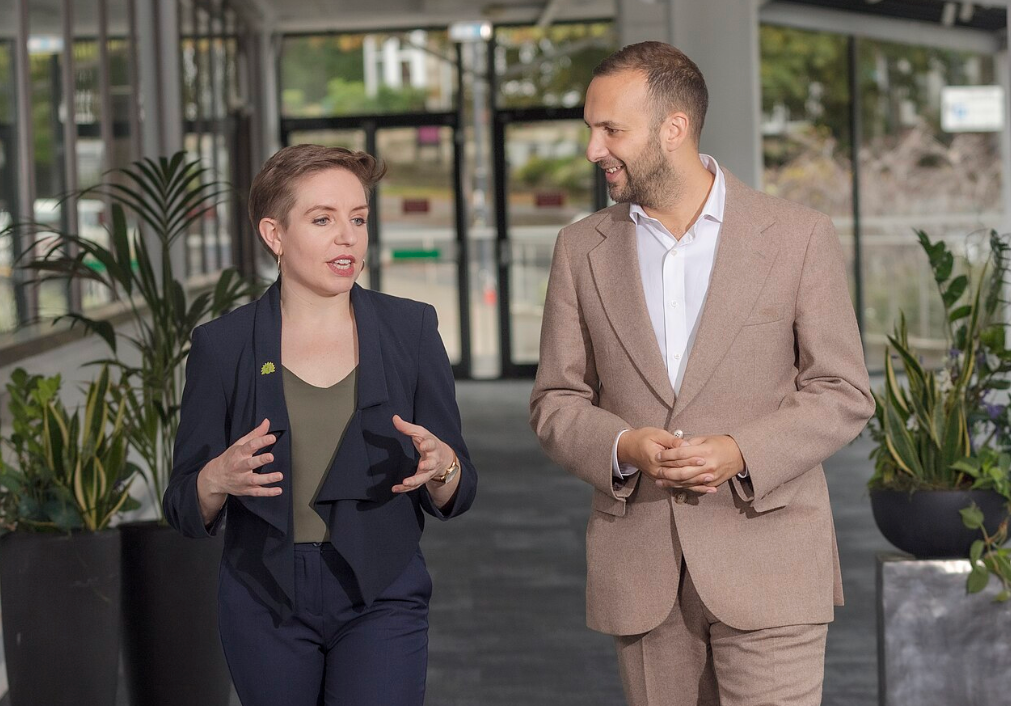
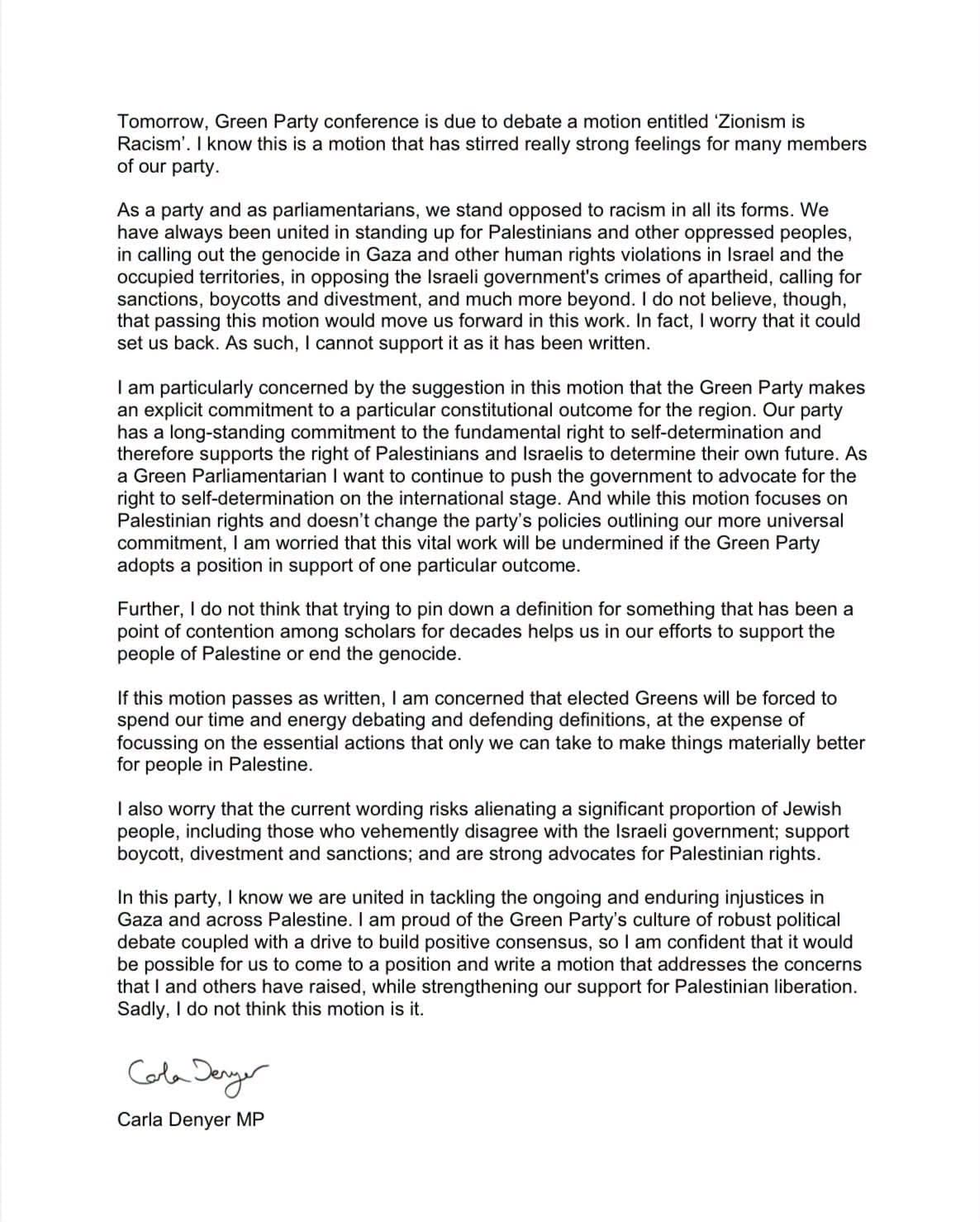
As Carla Denyer, former co-leader of the Green Party of England and Wales, and current MP for Bristol, said:
"I do not think that trying to pin down a definition for something that has been a point of contention among scholars for decades helps us in our efforts to support the people of Palestine or end the genocide. If this motion passes as written, I am concerned that elected Greens will be forced to spend our time and energy debating and defending definitions, at the expense of focussing on the essential actions that only we can take to make things materially better for people in Palestine."
Em Hilton, co-founder of Na'amod: UK Jews Against the Israeli Occupation, and one of the staunchest and most high-profile anti-Zionist Jews in Britain, posted similar thoughts, as part of a longer critique that I encourage you to click through and read in full:
As she writes further in, "in the current political conditions of the UK, refocussing the public conversation around Zionism is a gift to the Right. They can distract away from genocide, or arms sales, or nakba, and back onto one about emotions or ideology."
This is the thing: not only is the motion pointless performativity, but it's bad politics. It undermines the capacity to actually contest things that matter. And it undermines any political project seeking to bring people together across difference - which surely must be our goal, if we are to face this shaking, juddering, turbulent world together.
And, other than to have a bit of a cathartic rant, that's mostly what I actually wanted to say in this post. It's returning, in part, to the argument I made early this year in what remains I think one of the more important pieces I've written recently: on the necessity - and limits - of left populism:
 Tim Hollo
I suggested, in that post, that left populism has a contradiction at its heart: it is inherently a critique of the system - setting up a mass of the people against the system of power - but it needs the system to work in order to succeed. I wrote of my concern that populist electoral organising would lead back down the same route and end up undermining itself.
One of the aspects of that is the way the structurally "us vs them" approach of populism mirrors the adversarialism inherent in the political system as it currently exists. As I wrote:
"yes, all politics needs some adversarialism, but a politics which is structurally adversarial drives us into what Sarah Stein Lubrano calls "wildly unhelpful binaries" which then risk encouraging inanity and discouraging serious conversation, discouraging actually working to change people's minds rather than telling them they're wrong so you feel better about yourself. Consequently, at its worst, it often doesn't just sideline but actively distrusts genuine community-building that seeks to bring people together across difference, opening our doors and hearts to people to change their minds (not just to enter a coalition of convenience with their prejudices). To be clear, I'm not saying either the Mamdani or Polanski projects are currently doing this. They're actually doing a remarkable job so far of avoiding it. But the "the people vs the powerful" structure of populism presents it as a risk to be managed.
I'm going to return to this rather large and tricky question of adversarialism in campaigning in the hopefully not too distant future, so forgive me for raising it and moving on for now."
Well, here I am returning to it, though again only briefly, for the time being.
I think what we have with this motion is a classic example of the "wildly unhelpful binaries" which people are fed up with in politics-as-usual. They see politicians fighting over words instead of working to improve people's lives and they understandably turn away.
Again, this is something right wing populism can indulge in, because it thrives on division, and it wants the remnants of democracy to crumble. If a left populism wants to cultivate deeper democracy, it needs to create space for people to come together across difference. Performative binaries won't help that.
Further, as I said in February:
"A related risk here is that this binary structure of populism is necessarily simplifying - both of causes and solutions. And this is a trap which I do worry both Zohran and Zack fall into. There is a sophisticated systemic critique underpinning their politics, but the rhetoric boils it down to oversimplified lines about donations and taxes. Instead of grappling with complexity, recognising how fundamentally entangled capital and liberal democracy are, they encourage supporters to believe a simple fix is feasible. That only takes you so far before you hit structural barriers and need to start dismantling systems and constructing new ones."
I know, I know. The "it's complicated" argument about Israel/Palestine is always used conveniently to dismiss legitimate criticism. And also... it's not as simple as many campaigners love to say it is. At least, not if you're genuinely seeking a pathway forward which involves resolution of deep conflict and a way for people who've been fighting for three generations to live together in peace. That will be a long, hard road to travel, and, as with any conflict resolution, labelling people is a barrier we need to stop throwing in the path.
Arendt made an important observation about political parties, and the way even revolutionary or insurgent parties swiftly become enclosed and co-opted by the system they operate in:
“We have become so used to seeing domestic politics in terms of party politics that we are inclined to forget that the conflict between the two systems has actually always been a conflict between parliament, the source and seat of power of the party system, and the people, who have surrendered their power to their representatives; for no matter how successfully a party may ally itself with the masses in the street and turn against the parliamentary system, once it has decided to seize power ..., it can never deny that its own origin lies in the factional strife of parliament, and that it therefore remains a body whose approach to the people is from without and from above.” (On Revolution, p248)
Are Zack Polanski's Greens operating as a mass of the people targeting a corrupt system? Or are they part of the system, separate from the people? I think the members moving this motion think that it shows they are against the system, but it strikes me that, by operating in this adversarial, simplifying, binary, performative way, they are demonstrating themselves to be part of it.
Even with a populist approach, critiquing and taking on a system it labels as corrupt on behalf of the masses, a political party risks getting dragged into it, unless every effort is made to contest it at a systemic level, not just as bums on seats.
If you're not getting members and supporters out in communities, helping people find their collective agency, working together to make their lives better, the gravitational pull of adversarial parliamentary argument will suck them in. Indeed, if all you give them to do is electoral campaigning, the black hole will suck them in ever faster.
Instead of working on material issues with people where they are, you become another version of what you were fighting against.
And the impact of that, of course, is that the populist image of a party struggling against the system for the benefit of the people swiftly collapses.
As Arendt told us in On Violence, "All political institutions are manifestations and materializations of power; they petrify and decay as soon as the living power of the people ceases to uphold them."
Build power on the idea of contesting a corrupt system and then argue about words the way the system always does, and the power you build will crumble.
I strongly suspect Polanski will lose the upcoming by-election he is contesting. I think he was already going to, but I strongly suspect this motion makes it more likely he will lose. But that's almost by the by. If he does succeed in getting into Westminster, he automatically loses one of his great strengths: being truly an outsider critiquing the insiders. Whether or not he wins, his project has squandered its momentum, and its truly radical possibilities, by choosing to focus all its efforts on electoral gains instead of collective material change in and with communities.
I hope to be proven wrong.
But I leave the last word to Hannah:
“What first undermines and then kills political communities is loss of power and final impotence; and power cannot be stored up and kept in reserve for emergencies, like the instruments of violence, but exists only in actualization. Where power is not actualized, it passes away, and history is full of examples that the greatest material riches cannot compensate for this loss. Power is actualized only where word and deed have not parted company, where words are not empty and deeds not brutal, where words are not used to violate and destroy but to establish relations and create new realities. Power is what keeps the public realm, the potential space of appearance between acting and speaking men, in existence.”
Hannah Arendt, The Human Condition, p200.