After the no longer - farewell to Sydney Uni
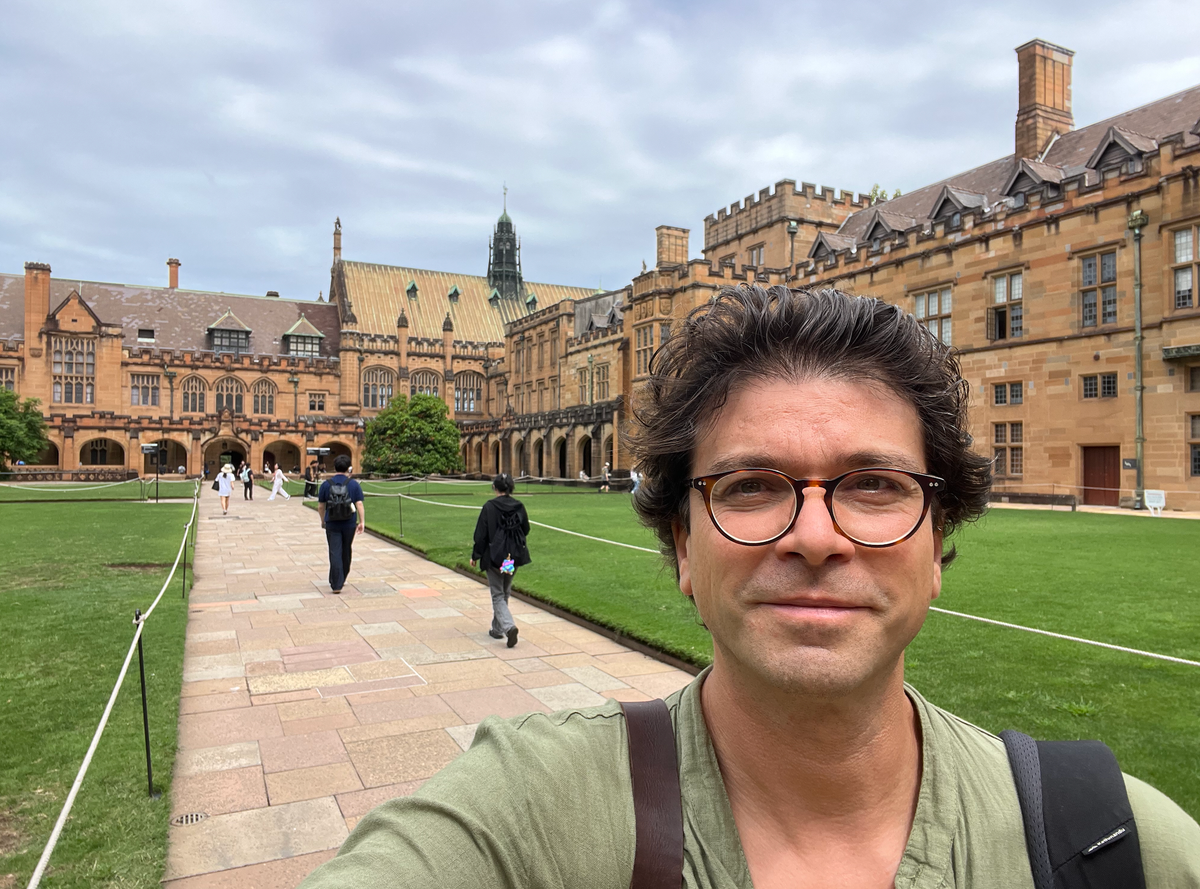
A year to the day since I posted here about how this new blogletter was actually an excuse to help me practice writing and thinking through my doctoral research, I can share today that I am shifting my enrolment from Sydney Uni to ANU, following Sydney Uni's appalling act of intellectual vandalism in abolishing the Sydney Environment Institute.
I only chose to enrol at Sydney to be part of that fabulous space for thinking, supported and guided by my wonderful, brilliant supervisors, Danielle Celermajer and David Schlosberg. With David now in Helsinki and the Institute dismantled, it no longer makes sense to be enrolled 300km from where I live.
I am tremendously grateful to Sharon Friel for warmly welcoming me to the School of Regulation and Global Governance (RegNet) at ANU. Sharon and Beck Pearse will hopefully be holding my supervision together at ANU, rounding out an incredible team to help me with this research, with Dany and David continuing to be my key intellectual guides. ANU is even re-setting my clock, and giving me a 3 1/2 year scholarship starting now.
Hilariously, given my research is about how difficult it is to let go of the past as we situate ourselves in the world-as-it-is-becoming, Sydney Uni completed my disenrolment in seconds flat. It seems they make zero effort to hold onto people. Ah well. They are now in my past. Onwards!
If you're keen, pasted here is my updated research proposal.
After the “No Longer”:
Collective Practices of Political Transformation and Liberation in a World on Fire
Synopsis and key literature
The arrival of the climate crisis and democratic crisis as lived realities has thrown into stark relief questions of time – of past responsibilities, foreclosed futures, and a confusing and confronting present. This has important implications for understandings of agency, power, and freedom, and, consequently, possible paths for action.
In politics and civil society, discourses of utopia and dystopia, of return to an imagined past or transition to an imagined future, of urgency and inevitability, of certainty and culpability, abound. In the academy, temporality has become a central site of analysis, through narratives of the Anthropocene,[1] of post- and de-colonialism,[2] of transition and transformation,[3] of rupture, repair, cleavage, and turbulence.[4]
However, both in research and practice, these temporal questions remain largely enclosed within a modern, rectilinear view of time, with history as process sweeping us along predetermined pathways, forever trapped in a permanent present, limiting our possible imaginaries and action.
Introducing Hannah Arendt’s conceptualisation of time opens up new possibilities for both analysis and practice. Arendt’s examination of “facing up to, and resisting… reality” in “the chasm between the no longer and the not yet” articulates a sophisticated critique of history as process which enables deep analysis of the way our understanding of our orientation with respect to time influences our capacity to act. She sets out how modernity has lost its connection to its past, and yet the “weird longevity of obsolete bodies politic” sees us playing given roles within those bodies politic long after they have lost their meaning. She warns of the risk of being swept away by the propulsive force of action set in train without experience and thought. And she offers the tremendous possibilities to be found in experience – in thinking and acting together, “in concert”, in the present moment, stepping into a true, “nonsovereign”, plural, freedom to change the world.[5]
There are remarkable, and perhaps surprising, echoes between Arendt’s critique of modernity, of its abstractions and individualism and its relationship with time, and much First Nations and decolonial thought.[6] They engage similarly with relationality, plurality, nonsovereignty; with being in between, both and neither at the same time; with natality, renewal, and world-making. Similar echoes can be noticed with ecological, multispecies, and eco-feminist literature.[7] Teasing out these points of similarity, as well as differences, enables a deepening of the analysis and new pathways for practical application. And interweaving this approach with recent political theory on temporality, and with movement theory and movement writing on theory of change,[8] enables a new set of radical, transformative possibilities to emerge.
Drawing together these theoretical threads reveals how modernity’s rectilinear understanding of time traps political action, ironically, in a permanent present, and how practices that help us interrupt the flow of time and reorient ourselves in relation to it might create the space for emergence, transformation and liberation at a moment of disintegration.
Now, between contested histories and foreclosed futures, agency and freedom in the present are stripped away. In this context, accelerated further by new technology and techno-determinism, the individual desire for control of one’s future underpins the rhetoric and aesthetic of both right-wing populism and climate action. Change is located in a utopian future reached through controlled transition for the climate community and a “retrotopia”[9] for the populist right, while, contradictorily, the right has become politically transgressive, seeking to overturn the system, and the progressive left effectively politically nostalgic, seeking a return to a time when liberal democracy “worked”. A chasm opens up through different experiences of the same problematic understanding of time.
An Arendtian analysis allows us to ask what might become possible if we could let go of, and loosen the hold of, the “no longer”, drag our locus of change from the future to the present, and develop the experiences together we need for the “not yet” to emerge. By interrupting the flow from past to future, disrupting the teleology, and taking a deep breath, could we transform ourselves together in the now in ways which make a radically transformed “not yet” possible
What practices might help us to do so, and in so doing to let go of human supremacy and of individual control, as they also help us to find collective agency, to step into our freedom by “acting in concert”? And might these practices enable liberatory transformation of political institutions, practices and imaginaries in a way more suited to this moment in history, after “the no longer”?
Central research questions
1. What types of collective practices can be identified that help interrupt the flow of rectilinear time, enabling participants to stop, breathe, and have an honest encounter with the end of the “no longer”, to let go of predetermined paths to a predetermined future, and embrace the possibility of emergence?
2. What particular skills and experiences are involved in these practices, which help participants recognise that the agency we are told we currently have is a mirage and begin to become the people they need to be, individually and collectively, in order to let go of the “no longer” and emerge into a “not yet”?
3. What impact do these practices and skills have on participants’ perception and experience of their own (individual and collective) agency and freedom?
4. Practices are often studied in terms of how they re-orient our relationships with each other through our relationships with place. What is going on in these practices that help re-orient participants’ relationship each other through their relationship with the flow of time?
Theoretical Framework
My theoretical framework is grounded in the Arendtian refusal to be categorised and embrace of plurality. I am also fascinated by and drawn to her approach of analysing ideas and practices through apparently contradictory juxtapositions.
Informed by both Arendt and decolonial theory, as well as recent post-materialist and sustainable materialist literature, it is grounded in practice and experience as generative of ideas and worlds. It understands practitioners as co-creators of the theory, not subjects of research.
It also places the research in service to the practice, not as an abstract process. The research must be of use to practitioners, both in its outcomes and in its process – helping work through strategic and tactical questions in practice.
Research Design
The research will be a qualitative study, involving participatory observational analysis, narrative analysis, and semi-structured interviews with participants, focussing on three case studies in the context of the broader ecosystem of practices. This will enable a picture of practices, barriers and pathways to emerge.
Selection of case studies will be key. I will be focussing on the close inter-relationship between the climate crisis and the democratic crisis – the similarities and differences between practices which seek to address each, separately or together, through interrupting the understanding of our place in the flow of time. I am looking for spaces where we can think and act about climate justice, the rising far-right, and community-building – responding to the “world on fire” scenario. I can envisage still focussing on Rising Tide, as addressing climate justice and the rise of the right and destruction of politics-as-usual in the Hunter region. The Global Optimism / Plum Village approach could also potentially be related with the democratic crisis, from a local to geo-political perspective.
I will conduct an initial narrative, linguistic and rhetorical analysis of the communications these case studies use, both internally and externally, to articulate their activities and approach to making change. This will enable a baseline picture of how these groups / organisations / communities describe their relationship with the flow of time, and their agency, power and freedom within and around it.
This analysis will be followed by observation of case studies – attendance, participation and observation of practices, and how those practices are explained and articulated. How does participants’ behaviour change in relation to those practices?
Following initial observation, I will conduct semi-structured interviews with participants. The interview approach will be emergent, and in interplay with observations. The intention is to draw out understandings of the observed practices, with an interest in any tensions and juxtapositions between what is said and what is practised. I will be looking for proxies for understanding how people feel their place in the flow of time, rather than seeking direct answers to specific questions.
In the observations and interviews, I will also seek to draw out differences between the case studies and the broader ecosystem of movement and community practices.
I am aware of ethical considerations regarding this research, in particular regarding participants’ experience of trauma in relation to the climate crisis and the democratic crisis, with the rise of far-right politics. I am conscious of the need to build trust with participants, and to ensure that the research is supportive rather than extractive. In some cases, there will be legal considerations – observing and interviewing people and groups potentially involved in nonviolent civil disobedience. Anonymisation of both observation and interviews will be crucial.
Positionality Statement
I come to this work with a background in both theory and practice, and as someone who has for 25 years been embedded in the political movements I seek to study. I am conducting this research not simply out of interest, but with a deep and abiding personal commitment to the success of these movements for change, and a belief in the possibility of transformative change. I have been and remain an active and somewhat influential participant in some of the case studies, and know personally some of the people I intend to interview.
On this basis, I will take extra care to seek prior and ongoing consent in observation of activities in the case studies, and clearly set agreed terms for both observation and interviews.
Possible Chapter Outline
1. Introduction
2. Thinking time: ideas of temporality
a. Making time: Practice – acting and thinking between past and future, world-making, experiencing the revolution before it happens, constant re-making vs petrification through disconnection from the making
b. Time together: temporality and relationality, agency, nonsovereignty, promises, reciprocity
c. Free time: temporality and freedom, trap of “playing a role”, mirage of agency and power
3. Taking time: practices of temporality
a. Decision-making, accountability and governance
b. Mutual care and provisioning
c. Opening the self
4. Saving time: Avoiding co-option and recapture
5. Conclusions
6. Appendices etc
[1] Dryzek and Pickering, The Politics of the Anthropocene; Tonder, “Five Theses for Political Theory in the Anthropocene.”
[2] Machado de Oliveira, Hospicing Modernity; Whyte, “Indigenous Climate Change Studies”; Whyte, “Too Late for Indigenous Climate Justice”; Sultana, “Political Ecology III.”
[3] Mehta et al., “Transformation as Praxis”; Hölscher et al., “Transition versus Transformation”; Stirling, “Emancipating Transformations”; White, “Technocratic Myopia”; White, “Transition.”
[4] Curato et al., “Deliberative Democracy in an Age of Serial Crisis”; Cwerner, “The Chronopolitan Ideal”; Fitz-Henry and Winter, “Temporal Turbulence in the Polycrisis”; Hanusch and Meisch, “The Temporal Cleavage”; Hendriks, Mending Democracy; Müller, “Political Theories of Climate Temporality”; Schlosberg, “Turbulence, Converging Crises, and Environmental Justice”; Thaler, “Transition or Interregnum?”; Thieme, “Beyond Repair.”
[5] Arendt, “Reflections on Violence”; Arendt, On Revolution; Arendt, Men in Dark Times; Arendt, Between Past and Future; Arendt, The Origins of Totalitarianism.
[6] Akomolafe, What Climate Collapse Asks Of Us; Graham, “Aboriginal Notions of Relationality and Positionalism”; Machado de Oliveira, Hospicing Modernity; Simpson, Theory of Water; Whyte, “Indigenous Science (Fiction) for the Anthropocene”; Moreton-Robinson, The White Possessive.
[7] Celermajer, Grounded Imaginaries; Celermajer et al., “Climate Imaginaries as Praxis”; Gunderson, Panarchy; Haraway, “Anthropocene, Capitalocene, Plantationocene, Chthulucene”; Keller and Rubenstein, Entangled Worlds; Krause, Eco-Emancipation.
[8] Brown, Emergent Strategy; Graziano et al., Pirate Care; Klein, Doppelganger; Lederach, “On Mass and Movement”; Solnit, The Beginning Comes after the End; Schlosberg and Coles, “The New Environmentalism of Everyday Life”; Schlosberg et al., “Critical Environmental Justice in Contemporary Scholarship and Movements.”
[9] Hanusch and Meisch, “The Temporal Cleavage.”