Inexplicable monsters

Thinking about One Nation with the help of Rebecca Solnit (and Hannah Arendt)
For [many people], the present seems to be perpetual, unchanging, unyielding, offering confidence or despair that the future will be like the present, a conclusion that seems to be drawn from the lack of recognition that the present is a radical departure from the past. In this viewless view, no old world is dying, no new world is being born, though this short-term perspective doesn’t exclude the monsters, it just makes them inexplicable and maybe undefeatable.
Rebecca Solnit, The Beginning Comes After The End, p25
Like so much recent commentary (including my Living Democracy), Rebecca Solnit's new short book, The Beginning Comes After The End, takes Antonio Gramsci's famous line about the old world dying and the new struggling to be born and this being the time of monsters, as one of its guiding metaphors.
Solnit's observation above, evoking the feeling of unmoored timelessness that leaves us struggling to come to grips with the reality we live in, interestingly points to why I now prefer Hannah Arendt's nuanced concept of the chasm between the no longer and the not yet.
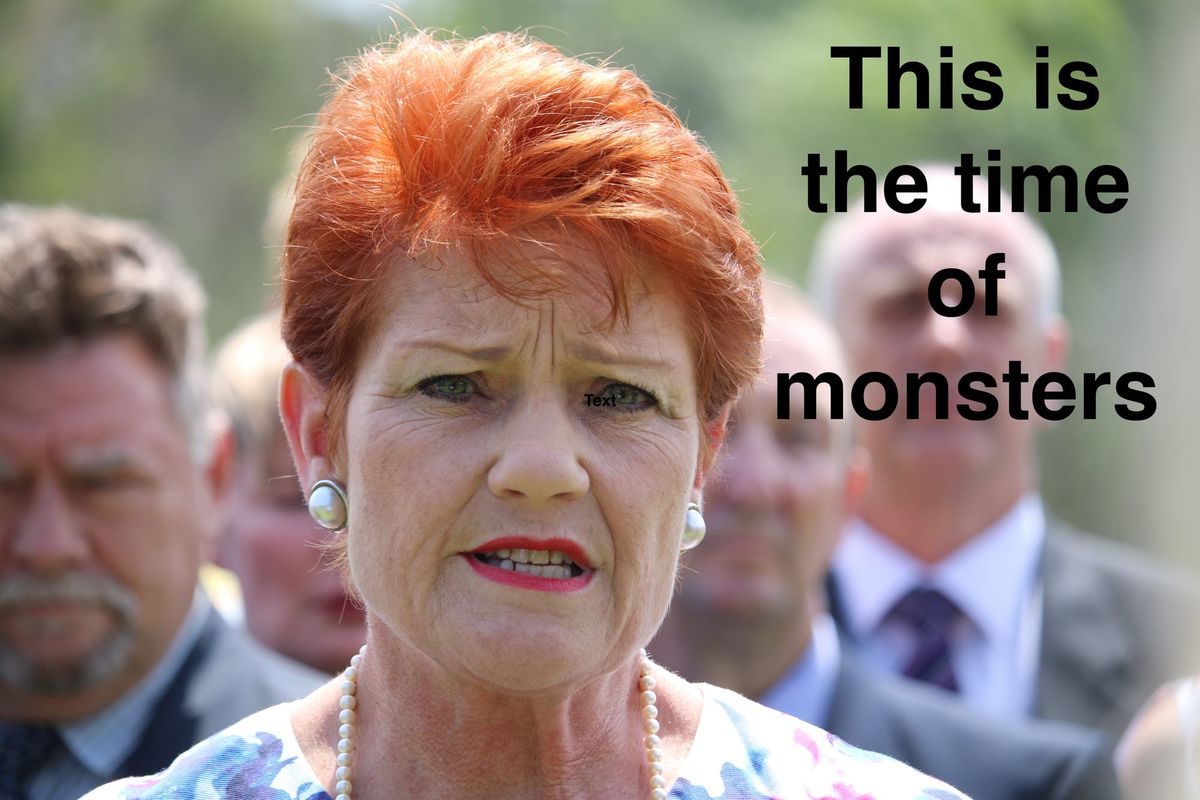
Compared with Gramsci's Marxist historical determinism, with the arrow of time pointing inexorably forwards, there's so much more possibility when we think about time and our positionality and directionality in an Arendtian way, as I explored in this recent post about "progress". But then we'd miss the opportunity to paint this excellent word-picture of "inexplicable monsters"! Doesn't it just immediately and hilariously call to mind the image of Pauline Hanson, or Donald Trump, or Nigel Farage, as they're seen by much of the broad left?
Whether it's the permanent present of the disengaged that Solnit is talking about, or the confident concept of progress I recently wrote about, this picture of Brexit, Trump, Hanson appearing suddenly as "inexplicable and maybe undefeatable" monsters helps makes sense of the kind of unhinged, unstrategic reaction we often see. "We have to convince them not to be racist!" "We have to stop defending trans people!" "We have to punch Nazis!" "We have to drop any talk of climate and environment and only focus on cost of living!" "We have to build a movement strong enough to defeat them at the ballot box!"
Of course, when you take another step back, it also makes sense of how "they" see "us". To One Nation voters, we - immigrants, climate activists, trans people, Greens voters - are inexplicable monsters arising suddenly out of a perpetual present, to whom the only reasonable reaction is to seek to kick the table over.
As Solnit points out, in actuality, the "monsters arise out of the attachment to the dying order" (p15) - an idea which is perhaps clearer in the original Gramsci, often translated as the "morbid symptoms" of the old world persisting into the interregnum. This corresponds to Arendt's "weird longevity of obsolete bodies politic" (On Revolution, p116) that I discussed last week. We stagger on, knowing deep down that the past is no longer propelling us forward because we've lost its original force, but we still hold onto it, not yet able or willing to let go and step into our power to simply act, in this space, to create something new. So, left or right, progressive or conservative, we flounder about reacting to events and getting angrier at each other because the world isn't responding the way we've been brought up to think it should.
What Arendt calls us to do is to stop just reacting and start the hard work of "facing up to, and resisting of, reality—whatever it may be or might have been" (Origins of Totalitarianism, p xviii).
The challenge I take from this is, most simply, how do we act to address the conditions which led to the rise of One Nation, instead of reacting to their rise? Or, perhaps more deeply, how do we live deliberately in a way that enables us to leave behind the no longer that both they and we are, contradictorily, nostalgic for, and, collectively, forge a path into the not yet - a path that will transform us all as we go?
I think Solnit encapsulates the crucial final part of this idea beautifully:
"you do not have to picture the destination to reach it or at least draw closer to it, you just need to choose a direction and keep on walking – though that metaphor makes it sound as though it already exists, if at a distance, rather than that the process itself creates it and covers the distance between the idea and the actuality." (p12)
We don't need to know and define every aspect of the not yet before we start. Indeed, we can't. Because the actions we take together here in the chasm, what Arendt might call the creative "spirit of the revolution", are what call it into being.
My dispute with Solnit, throughout the book, is that, despite the fantastic clarity of this revelation, she's more generally unclear about where we need to look as we walk. Are we carefully watching the ground in front of us as we take it step by step, scanning for snakes and bumps? Do we need to have the distant mountains in constant view? Do we focus on some foothills in between? Or do we need to look inwards to realise the mountains aren't far away, after all, but inside us, in how we choose to act? At different points she seems to be arguing for each. To be fair, of course, we're all struggling with this tension. But I felt unsatisfied by how the book failed to grapple with it as a tension, and too often glossed over the different approaches in its narrative of hopeful progress.
It's useful to bear in mind here, too, of course, that Hanson and friends do not make any genuine attempt to picture their destination. Much has been made recently of the fact that One Nation has no policies to speak of. They have a structure of feelings - of grumpy feelings! Less than a direction they want to walk in, it's more of a performative style of walking. But then so too is ours on the left, much of the time, isn't it?
Perhaps, instead of walking at all, we're all just trying to keep our balance in this unsteady world, when the ground has fallen away beneath us. Arendt sets out, in Between Past and Future, how we've lost the grounding of tradition and authority, lost our shared reality. If what follows is social atomisation, that leaves the space for totalitarianism to emerge, and that's what One Nation banks on - and drives - so effectively. If, on the other hand, people and communities choose to act in concert, cultivating new spaces of collective freedom instead of insisting on the illusion of their own individual freedom against everyone else, there's the possibility of truly creative revolutionary change.
I fear that Solnit's narrative, of slow, painstaking progress, facing a backlash but still moving in the right direction, while valuable for keeping our spirits up, underplays the potential for dramatic, swift change - in either direction.
One of the conclusions of Solnit's book is that we've seen "a revolution in the nature of revolutions" - that we're already achieving transformation through incrementalism instead of "sudden regime change" (p119). I found myself wishing she'd studied Arendt's On Revolution, with its remarkable analysis of how the American Revolution was effected before it began, because the people had deep experience of doing democracy together, and the real, lived power of the monarchy had already largely melted away. But the revolutionaries still had to dislodge the institutional power of the monarchy in order to complete it.
I do genuinely love this insight of Solnit's that, in symbolic terms, another revolution has already been effected:
“After a revolution, after regime change, old statues of the old regime’s heroes and rulers come down, names are changed to reflect new heroes, and new values, to change the story through public language and public monuments. In our time, this process has been happening as if there has been a revolution, and perhaps it can be taken as a sign that there has been.” (p125)
Yes, in many ways the not yet is already here. But the no longer is also still hanging on. Consequently, the backlash isn't just at the margins - it goes all the way to the heart of power.
But it is a backlash. To return to Solnit's metaphor of choosing a direction and walking, Hanson's "I don't like it", is, fundamentally, a walking away rather than a walking to. As is Trump's "Make America Great Again", and Brexit's "Take Back Control". The populist right's project is what Anand Giridharadas calls "a mourning" rather than "a launch" (p128) - mourning their lost right to dominate others. They're walking away from the normalisation of kindness, of respect for difference, of the recognition of interdependence, as Solnit articulates it, and I absolutely agree.
And then Hannah Arendt comes along and, again, takes it to an extraordinary depth. The recognition of interdependence is, in her terms, an appreciation of the reality of "nonsovereignty" - that the concept of individual, sovereign agency is a modern fiction, since action only makes sense in plurality, in interaction with others. As she noted, quantum physics had already proved this, and since her death, ecological sciences have demonstrated it further. The desperate clinging to the fiction of sovereignty we see today is one of the aspects of the obsolescent no longer, and it intertwines with her challenging of linear time and history as process in ways that I'm still wrapping my head around.
The chasm between the no longer and the not yet consists, in these terms, in the collapse of a set of fictions that held together our shared reality. The wannabe dictators know their right to dominate is lost, and isn't coming back. They tell themselves and each other that they can hold it together by sheer force of will, or through violence if necessary. They know it won't work, but they're willing to tear shit down to try, because they can't yet understand otherwise. How different is Donald Trump hurling bombs and curses from the White House from a Sovereign Citizen shooting cops in Porepunkah, or from a climate denier rolling coal in a child-killing pick-up truck? It's all a matter of degrees.
This, then, is how we explain the inexplicable monsters. But it still leaves the question of how we defeat them. Because, even if some of the normative power of the old world is already gone, the institutional power remains. Science and Arendt and the lived experience of so many of us may have proven that sovereignty is a myth, but it remains the structure and core of institutional power in liberal democracy as in capitalism. Individual sovereignty, state sovereignty, rights, legal liability, personal liberties, borders, government separate from the people.
And this clash of realities turns the inexplicable monsters back on us.
Because we're still embedded in this dying sovereign system, we react to the rise of right wing populism in one of two ways.
As Solnit says, and as I've also been muttering for a while, “When facing the backlash against the new world being born, many radicals and progressives find ourselves in the unfamiliar position of defending institutions and the new status quo” (p65)
Many others swing into left populism which, though far more inspiring, is also fraught, as I articulated recently here.
Both are reacting from within the no longer.
What if we chose to act instead of react?
What if we stepped into our collective freedom, facing up to and resisting reality, and began to create something new together?
Solnit has a wonderful example along these lines, exploring part of the Civil Rights movement through the eyes of the extraordinary activist, Grace Lee Boggs, who
“wrote late in her long life that the bus boycott was “the first struggle by an oppressed people in Western society from this new philosophical / political perspective. Before the eyes of the whole world, a people who had been treated as less than human struggled against their dehumanization not as angry victims or rebels but as new men and women, representative of a new, more human society.” They acted, in other words, not only on the basis of the rights they lacked, but on the spiritual strength they had in abundance; acted to take and also to give.” … “Later, we’d come to call that prefigurative politics, the way that you can and should embody what you aspire to.” (p36-37)
Maybe the way to explain and defeat the monsters is to embody interdependence as much as we possibly can - to expose the illusion of independent sovereignty while cultivating the reality, the lived experience, and the new institutions, of interdependence.
Going to keep trying to work.that out for a while. Hope you'll join me.
PS: By the way, I'm doing a webinar for the Degrowth Network Australia on Paths to Degrowth, which will explore some of the ideas rattling around my head on actually doing the "facing up to and resisting of reality" I keep mentioning, next Thursday, April 16, 6-7pm. Register here to join the discussion and help us think our way through the chasm.