Direct Action for Degrowth
A transformative, liberatory political act of collective refusal and creation.
This is a lightly edited transcript of a presentation I gave last night to the Degrowth Network Australia (insta here) as part of its webinar series on Pathways to Degrowth.
Thanks so much to the Degrowth Network Australia for inviting me to take part in this big, challenging and crucial conversation about how we cultivate paths to degrowth - and for all the great work DNA does!
Before I go any further, I’ll acknowledge that I’m joining the conversation tonight from unceded Ngunnuwal and Ngambri country in the beautiful subalpine plains of what is now called Canberra. I pay my respects to First Nations elders past, present, and those still to come, here and around the globe. I’ve had the immense privilege of learning from some remarkable First Nations people - listening, in conversation, reading – about what it means to be in right relationship, with country, and with each other, understanding country as extended family, recognising that we are all intertwined. There are so many ethical, cultural, and very practical lessons we have to learn. And increasingly my view is that we have a lot to unlearn, to peel back, of what western modernity has told us about ourselves and the world and our place in it.
I also want to acknowledge Ted Trainer and thank him for his presentation last week, as well as his important work over so many years and decades. I hope the session I’m going to lead this evening is a useful counterpoint to his, setting out some agreements and some disagreements, and taking it in another direction.
I’m very conscious, in doing this, that I’m an invited guest of DNA here, and I come to degrowth, unlike Ted, not as someone who has made it my focus, but as someone who sees it as one crucial aspect of the broader struggles I’ve been a participant in for some 30 years – as a deeply committed activist for ecological and social justice, for deep democracy, for socio-cultural transformation in order to achieve these goals, and as the process for achieving them.
The question at the core of my current PhD research is, fundamentally, how do we let go? What are the practices – the collective, grassroots, embodied practices of living – that help us to let go of our attachment to the ways and ideas that have caused this polycrisis, so we can chart a course into what comes next?
One of the central ideas we need to let go of, obviously, is the mythology of growth, the inanity that we can have infinite growth on a finite planet. Another, that we’ll return to, is the story of the liberal democratic state – that we can outsource governing and expect decent outcomes. More deeply, it’s about letting go of extractivism, of domination, of the very separation of humanity from the natural world, and re-embracing our interdependence.
I see degrowth as a necessary aspect of this whole transformation. And I see the degrowth movement as one of the more promising spaces of action, being willing to engage at a deeper level with these challenges than most.
I’m also persuaded by Sam Alexander and others that, the thing is, degrowth is coming whether we like it or not, and it’s better to choose the path rather than have it chosen for us. And, for anyone paying even the slightest bit of attention to the world, it seems like it’s coming sooner than we might expect, whether it’s supply chain disruptions from pandemics and war like the Straight of Hormuz right now, or climate and ecological disasters, or food system shocks, or AI destabilising the house of cards that is the global financial system and the global economy. In this world of what David Schlosberg calls “turbulence”, overlapping wave after wave of shocks destabilising our foundations, the ever-growing, on demand economy is not going to last.
Degrowth is coming whether we like it or not, and it's better to choose the path rather than have it chosen for us.
So what paths should we choose?
One point of firm agreement I have with Ted’s presentation last week is that politics-as-usual is not a useful path. We may be able to occasionally use it, to support or encourage certain behaviours or actions, or more often to obstruct them a little less. To not bulldoze our gardens. To not put up barriers to cooperatives, to communal living, to sharing infrastructure. To marginally shift the social infrastructural affordances, to use the sociological language – the context in which we can make decisions about how to live in the world. But we cannot trust the state. The state – even the liberal democratic state, or what remains of it after decades of neoliberalism – is structurally exclusive, extractive, dualist. And it is structurally codependent with capitalism. It’s not just that the state won’t deliver degrowth – it can’t.
So the ideas I’ve seen circulating here and there – that we need a political party for degrowth? Please, no. We need to cultivate alternative governing and economic forms and institutions and practices, and use them to make the existing forms obsolete – the withering away of the state that Ted quoted from Marx last week.
On the other hand, one major point of disagreement I have with Ted is that degrowth needs to be disentangled from other important goals and focussed on independent of them.
In my very deeply held opinion, we share one struggle – one liberatory, emancipatory struggle from the worldview, and the institutions that uphold the worldview, of separation and domination. There are numerous aspects of that struggle that we need to respect and appreciate and choose to focus on depending on our passions and skills. For some that will be sharing practices, for others decision-making. It might be food, or making and repairing things, or gender and sexuality justice or anti-racist organising. They are different, but all entangled aspects of the same struggle.
I think it’s crucial to recognise this, and centre it in our organising, not just because it’s right, not just because it is vital for recruitment, but because we won’t succeed unless we understand it that way. We can’t do degrowth in isolation, because the growth economy is only one aspect of the cultural and institutional framework that creates it. You can’t pull at that one thread – you have to weave a new direction in our garment of destiny, to borrow from Martin Luther King.
Relatedly, and I guess to finally come to my point, I want to put a clear counterpoint to Ted’s framing of degrowth as a communications challenge and propose that the main pathway is through Direct Action.
One of the pitfalls of western modernity, and I think not unrelated to the trap of human exceptionalism, of separation from nature that underpins the growth mentality, is the mythology that we are a rational species led by ideas. We very rarely change our mind based on something we’re told. We very often change our minds based on the things we do, and in particular the things we do in community, in concert with others, as Hannah Arendt puts it. And this is particularly the case with values-laden ideas, or political ideas. A very long time ago, Aristotle made the case that “virtues are learned through habituation, and habits are formed through practice”, as Sharon Krause put it in her excellent recent book on Eco-Emancipation. And if you really want to follow that rabbit-hole, I highly recommend Sarah Stein Lubrano’s Don’t Talk About Politics.
Behaviour leads belief, and practice is the key. The task is not raising awareness of degrowth, but creating opportunities to do degrowth practices together. This is what I mean by Direct Action, and it’s amazing how effectively it can short-circuit difficult political conversations and disagreements.
I’ve often shared the story of how I established Canberra’s Buy Nothing Group movement, and administered my local group for many years. Every now and then, I would throw in a comment along the lines of “how cool is this radical anticapitalist organising we’re doing here?”, and people would splutter “what do you mean!? This isn’t radi… anticapi… oh. OK. So it is. That’s nice.” If I had tried to get people involved in an anticapitalist, anticonsumerist group, I suspect we’d still have a few hundred members. As it was, my initial group grew to thousands rapidly, sprouted into half a dozen, seeded more, and kept growing, and now one in ten Canberrans is a member of their local Buy Nothing group.
Similarly, there’s a great video I saw a while ago, an interview with a man at a Trump rally, a big MAGA truckie in his MAGA hat, and he’s waxing lyrical about how his friends in the next town over work for a tyre company where they all get to have a say in the jobs they do and share the profits of the company… He’s clearly describing a workers’ co-op, but if you told him it was a socialist idea, he’d punch your lights out.
My point is, too often, talking is a barrier, politics is a barrier. But doing stuff? That’s easy. It’s fun. And it’s powerful.
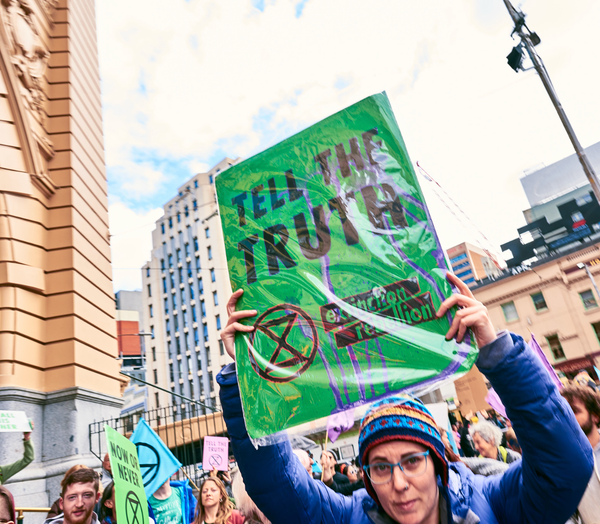
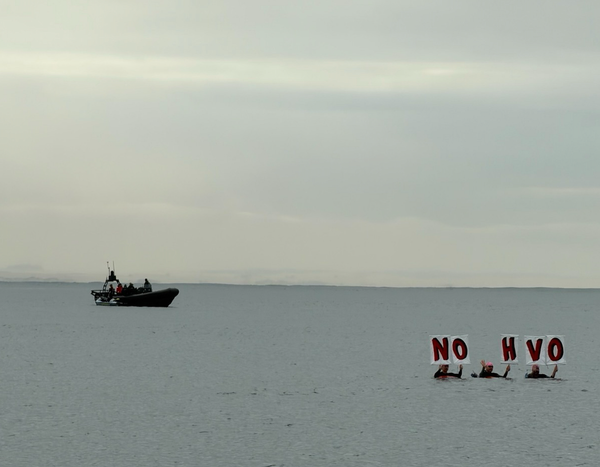
I use the term Direct Action with care. For many, it sounds like it implies nonviolent direct action such as blockades, and yes, it does imply that, but it’s broader than that, too.
The late great David Graeber described it as follows:
Direct action is a matter of acting as if you were already free.
The classic example is the well. There’s a town where water is monopolised and the mayor is in bed with the company that monopolises the water. If you were to protest in front of the mayor’s house, that’s protest, and if you were to blockade the mayor’s house, it’s civil disobedience, but it’s still not direct action. Direct action is when you just go and dig your own well, because that’s what people would normally do if they didn’t have water.
“Acting as if you were already free”. I love that so much. It ties in with my favourite Hannah Arendt’s conception that freedom appears when people gather together to act in concert and create something new. And it draws us into that idea of this work as liberatory! An exciting, joyous, powerful process of setting ourselves free from the chains this late capitalist hellscape binds us with! Doing things together, in this way, helps us to let go of the ways we’ve been trained in, far better than talking about it can.
We don’t have to buy that shit. We can borrow it. Or repair it. Or not have the latest gadget.
We don’t have to pay a multi-billion dollar corporation for the privilege of eating. Food is our right, and we can grow it and share it and bin-dive for it and gather consumer cooperatives to source direct from farmers. We can use our gardens and our balconies to grow it, and we can occupy public spaces to grow it, too.
We don’t have to source all the services we need in the capitalist market and work three jobs to pay for it. We can get our community together through offers and needs markets to work out what skills and resources we have around us to just get shit done for each other together.
We don’t have to scrimp and save and work long hours to pay for a tiny concrete box to live in or a white picket fence to live behind, on our own or in a nuclear family. We can share multi-family homes and knock down fences to create mini villages. We can squat in vacant homes and occupy short-term rentals. We can make rooms available for people in need, and we can push the boundaries to create cohousing arrangements.
We can just do it. And dare them to stop us.
--
OK, so, what about direct action as a pathway towards transformation?
Let’s remind ourselves briefly of the state of the world, and that idea of turbulence I mentioned earlier. The shaking of the foundations. A lot of people have been bandying around the famous phrase of Antonio Gramsci’s – the old world is dying and the new is struggling to be born. As some of you may know, I prefer the frame from Hannah Arendt – a frame I’m using as the theoretical grounding of my PhD – that we’re living in “the chasm between the no longer and the not yet”.
I love the uncertainty, the nuance, the flexibility, the complexity of this. Rather than the linear path of destiny, of historical determinism, here there is real acknowledgement of the multiplicity of being. As humans, in society, we are plural. Nothing we do has a single cause or single outcome. It’s all dependent on how others around us respond. When you add in more recent (or really much older, pre-colonial) thinking about our embeddedness in the more-than-human world, the plurality expands.
In this worldview, social change always emerges from our collective actions. But there are times when the possibilities expand, the multiplicities multiply, because the constraints of institutions and norms that narrowed the options available have fallen away. These are very confusing times. The past no longer propels us forward, but it still has a hold on us – in some ways more tightly than ever. We cling to our trust in the state, or our capacity to buy stuff, because we’re scared, we’re shaken. And the future is opaque, because we haven’t made it yet! What happens next is genuinely up to us! It depends on what we choose to do together. It IS what we choose to do together. And, with old constraints fallen away, our collective choice could be truly transformative!
Arendt has a fascinating perspective on the differences between the American and French Revolutions. This was an era of disruptions and uncertainty already. In France, the desperate poverty set against extraordinary wealth exploded into revolution without the people having practical experience of how to live otherwise, and it consequently descended into extreme violence and repeated institutional collapse. In America (quietly noting that it was a revolution of and for the white people only, of course), the monarchy was far away, and the people had practical, lived experience of doing democracy together, in town halls and village meetings. Genuinely, it was how they had been living, already. In some ways, she argues, the revolution was effected before it began.
I argue that we’re living in one of those moments between the no longer and the not yet. Arguably, the same long moment that Arendt saw emerging through totalitarianism, the holocaust, the nuclear bombing of Hiroshima. Add in the climate and ecological crises, the collapse in faith that capitalism will see us get ever more prosperous, the inability of the state to keep its promise to keep us safe… In some ways, the hold of the ideas of separation and domination is weaker than it has been for a long time. In others, it’s holding tighter, as our worries make us cling to the illusion of certainty that parliamentary elections and supermarket groceries provide. At the same time, the older ideas of interdependence, of mutual aid, of shared abundance, which have been within us all along, are already coming to the fore again.
This is a moment of extraordinary possibility. If more and more of us can now practise living degrowth, practise living in ways that deeply challenge the culture of separation and domination and open us to our interdependence, what, then, might happen?
I want to go back to that earlier quote from David Graeber about Direct Action being “acting as if we were already free.” What he said immediately before that becomes relevant here. He said:
Well the reason anarchists like direct action is because it means refusing to recognise the legitimacy of structures of power. Or even the necessity of them. Nothing annoys forces of authority more than trying to bow out of the disciplinary game entirely and saying that we could just do things on our own.
Aha. Direct Action is creating something new, and also disrupting the authority of the old, withdrawing our consent to its power over us.
Direct action disrupts, and it also creates. Sometimes it disrupts in order to create. Sometimes it creates in order to disrupt. If it’s to be transformative, it needs to provide pathways and cycles, iterative processes, bringing creation and disruption together in fun, engaging, exciting ways as people get ready to let go of more and more.
The abolitionist organiser and sociologist, Ruha Benjamin, has a beautiful articulation of this from a slightly different perspective:
Remember to imagine and craft the worlds you cannot live without, just as you dismantle the ones you cannot live within.
OK, so how about direct action for degrowth as a form of capitalist abolitionism? A liberatory, emancipatory, transformational project of disrupting and dismantling an already collapsing structure of power and planting our gardens in the wreckage, transforming us and our relationships as we do it, enabling us to become the people and the society we need to be to meet the moment.
Degrowth Direct Action has to be more than simply stepping off the hamster wheel. It has to be a political act of collective refusal and creation.
Capitalism needs constant growth and constant consumption, and that requires our consent and participation. The economy isn’t a real thing – it’s what we do. And we can do differently. Money isn’t a real thing – it’s an imaginary construct. If we stop treating it as real and powerful, if we stop believing in it, like Tinkerbell, it fades away!
Perhaps that’s not the best metaphor. Do we like Tinkerbell? Do we remember Tinkerbell? Not sure…
Anyway, my point is… the system has been made by human actions and it can – and will – be remade by human actions. By our direct action. Disrupting and creating.
What I want to ask you to do, in the time remaining, is have conversations together about what direct actions you could take on, in your communities, that bring together disruption and creation in this chasm between the no longer and the not yet. In particular, I want to invite you to think about key intervention points in the system where direct action that is both disruptive and creative could be powerful and inspiring.
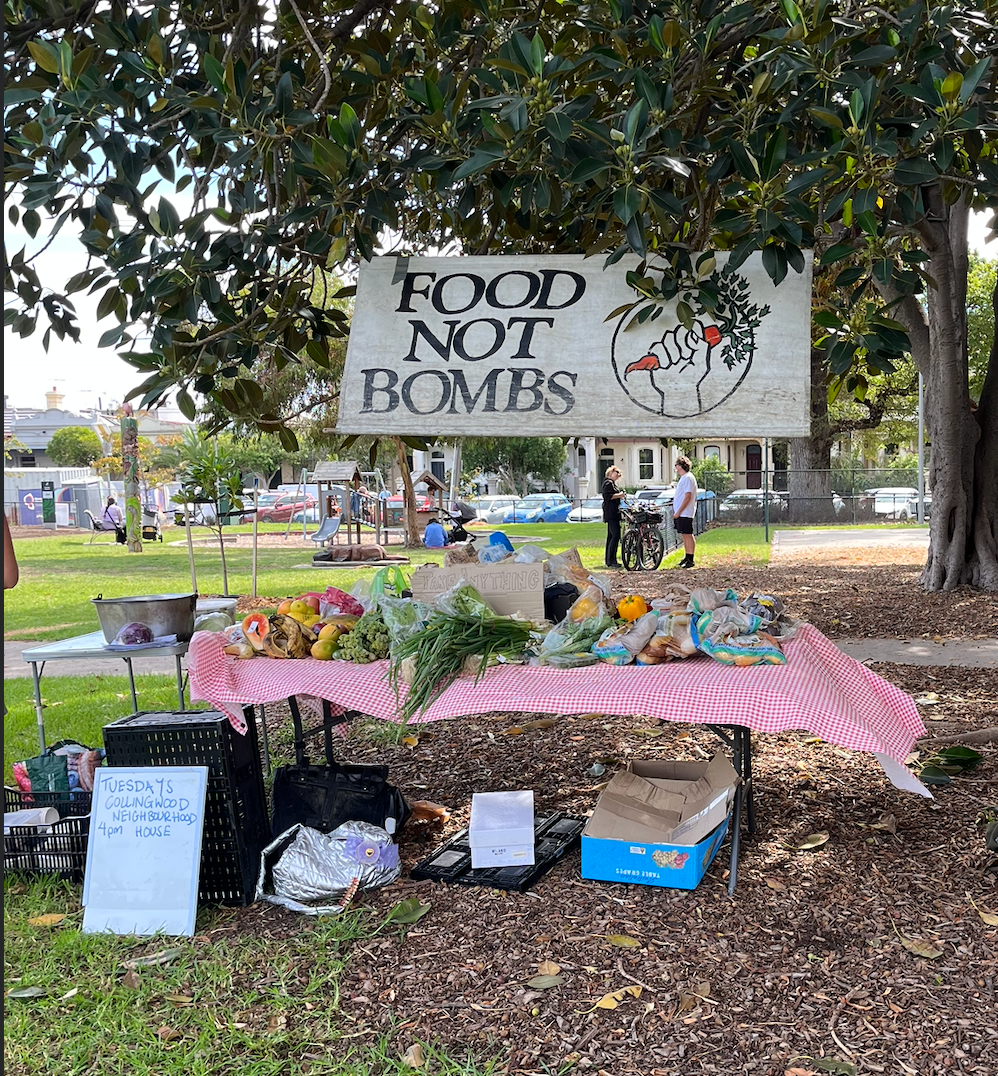
Food might be a great place to start. Can you do guerilla food gardening? What if you did it on a plot outside a C*les or W**lw*rths? What about a Food Not Bombs approach, bin diving for still decent food, cooking it up, and serving it free to people, outside the stores whose bins you took it from?
Our repair cafes – which I adore – are often in out-of-the-way places where you’ll never find it if you’re not looking. What about hosting one in a convenient spot like, oh, I don’t know, maybe a public foyer outside Cotton Off or Wig Bubbleyou or Hardly Normal? You wouldn’t need to block the entrance… Just an idea.
Maybe you want to think about transport. How about doing cycle repair jams that occupy obvious space alongside a road at peak hour? That one might be unpleasant and maybe dangerous, so it’s not my best idea, but you get the point.
It also doesn’t have to be directly connected, as these examples are. I’m so glad we took a Degrowth stall and workshop to the Rising Tide blockade, for example, helping people connect the direct action of the coal blockade to the direct action of cooking together, making decisions together through the Spokescouncil, doing de-escalatory camp security together…
What about occupying a site slated for a server farm for AI development, farming it, living well together on it, blocking the future we don’t want and living the future we do?
What about replacing public space advertising (one of my personal bugbears) with lovely pictures of birds, or trees, or mushrooms?
I do want to emphasise, these are ideas, not recommendations or instructions, and if you want to do any of this, it is important you investigate their legality and their safety and make an informed, thoughtful choice. As we get closer to the edge, the state will get more repressive (it already is, as it's hard to miss), but that is a reflection of the reality that it is losing its hold on power.
As we get deeper into that chasm between the no longer and the not yet it becomes only more incumbent on us to live together facing up to reality and choosing to resist it. Direct Action, disrupting and creating, becomes the transformative, liberatory, emancipatory, and so often fun and joyful, path.