Renovating the Master's House... while it's on fire

On stepping outside and rejoining the world
It took me a while, years ago, to come to grips with Audre Lorde's famous dictum that "the master's tools will never dismantle the master's house".
Investing so much of my life, my time, my emotional energy, in a theory of change that says there is no alternative to working in, with and through the system as it currently exists in order to change it, it was incredibly hard to acknowledge the truth Lorde points to - that it's the system itself that binds us. Using the tools of control, of separation and domination, of extraction, of oppression, can never create justice.
I've been thinking about it again, recently, while digging into literature about the distinction between transition and transformation, and re-reading chunks of Vanessa Machado de Oliveira's incredible Hospicing Modernity and other eye-opening decolonial writing.
A riff off the metaphor occurred to me.
Most of what we're doing in our social movements these days, most of the time, is renovating the master's house.
We've been busily polishing the floorboards and updating the kitchen. We've put some insulation in the ceiling cavity and subfloor and we've added an EV charging port in the garage. We've built on an extension with extra bedrooms, because, you know, growth. We've replaced the old inherited art with some nicely challenging contemporary works.
But it's not our house. We don't even have the keys!
The overwhelming focus on "influencing" "power-holders" reveals that we're only guests, tolerated at best, allowed in when it's convenient. Or we're brought in to provide services, used as props, or as extras, filling out their world-building picture in a nice simulacrum of democracy.
"See? Civil society is interacting with us! We are therefore legitimate."
Even when we're yelling at them, we're still acknowledging their power over us as legitimate.
Or, to really grapple with Lorde's metaphor, perhaps we're not guests or workers allowed in occasionally, but are locked inside, slaves to a system we cannot escape, partly because we can barely perceive the extent to which it keeps us bound. We don't even realise that we have to liberate ourselves. This is core to Sharon Krause's argument in Eco-Emancipation - that our cultural domination of nature "circles back to subjugate people too", through consumerism, planned obsolescence, pollution, foreshortened futures, and massively constrained experience. Shut off to the experience of interdependence, we don't even know what we're missing.
Either way, that's the point: while we're inside, as guests or slaves, our choices are tightly constrained, our imaginaries limited, our individual and collective agency stripped away.
And now, the house is on fire!
The ceilings are riddled with black mould and the walls with asbestos, making us sick.
The whole house is shaking and rattling in the turbulence of wave after overlapping wave of crises. It's a house not designed for these times.
The foundations are cracking.
Which actually isn't a bad thing. Because it reveals to us that it's the foundations that are the problem.
If we match up Lorde's "master's house" with the "house modernity built", developed by Vanessa Machado de Oliveira and her colleagues in Gesturing Towards Decolonial Futures, we are trapped by the house because its foundation is separability:
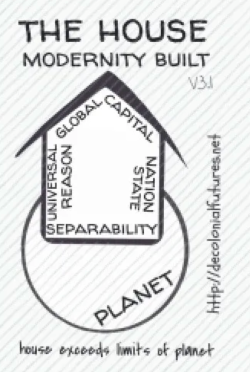
Machado de Oliveira defines separability at several levels. At its most obvious, it is simply "the imposed sense of separation between ourselves and the dynamic living land-metabolism that is the planet and beyond" (Hospicing Modernity, 20). This human exceptionalism leads to anthropocentrism, which is the model for all hierarchy and domination. This leads to logocentrism - the privileging of certain forms of knowledge, and the invention of the idea of objectivity - which is tied up with all the various forms of exceptionalism and domination within the human species - race, class, gender, age, ability, etc.*
In short, separability leads to hierarchy and the attempt to control those we deem lesser. This is the foundation of modernity.
She recognises it as a form of violence, when "the sense of metabolic entanglement ... is repeatedly and deliberately severed" (116). Because that entanglement, that connection, that interbeing, is beauty, is joy, is the beating heart of the experience of being truly alive. Severing it literally hurts - like cutting Lyra off from Pantalaimon.
Just as Krause articulates how the domination of nature "circles back to subjugate" us, Machado de Oliveira highlights the deep pain separability causes us:
Separability removes the intrinsic value of life that grounds relations of equanimity and an individual's inherent sense of self-worth. Hence, if your life does not carry intrinsic value, you will need to produce value within the economies of modernity in order to justify your worth, and why you deserve to be alive. (107)
The "intrinsic sense of belittlement, insignificance and worthlessness that comes with this sense of separation, of separability" (56), drives us to seek "external validation" through consumption, and participation in dominating, hierarchical, extractive systems. Whether it's retail therapy or posting for clout, gambling or hurt people hurting people, from inside the "house of modernity", we "cannot believe or imagine it is possible to feel well in a different way" (116).
Now, because the rules of this blogletter are that I must reference Hannah Arendt at least once in every post, I am obliged to note here how closely it seems to me this aligns with her critique of sovereignty. Following Rousseau, and Louis XIV's (possibly apocryphal) claim that "l'état, c'est moi" (the state is me), she articulates sovereignty as the undivided and indivisible will-to-power, "independent from others and eventually prevailing against them" (Between Past And Future, 163). Sovereignty, in these terms, makes a claim to underpinning freedom while destroying it for all, makes a claim to power while destroying it, makes a claim to satisfying needs while only creating more wants. And, in these terms, sovereignty is "an illusion, which, moreover, can be maintained only by the instruments of violence".
Sovereignty is separability. And it is also abstraction. Which also resonates strongly with Brother Phap Linh's abstraction rebellion that I wrote about recently.
We need to acknowledge non-sovereignty, to embrace interbeing, to reconnect. We need the walls to slide away, to open up the possibility of connection. But if the walls of the master's house keep us enclosed, it's the foundations that are the problem - the separability underpinning modernity's hierarchy and control.
And those foundations are cracking, as more and more of us open our eyes and hearts to connection, and plants start to grow in the cracks. The cracking foundations are shaking the walls and rattling the ceiling, as both the nation state and global capital begin to lose their grip on our imaginaries, and possibilities begin to expand. The whole structure is coming apart.
So why are we still polishing the damn floorboards?!?
We have to move out. We have to choose, deliberately, to leave that house. We have to get off those foundations, take off our shoes, run around barefoot in the grass, and while away the hours conversing with the flowers.
But here's the thing: recognising that the foundations are the problem lets us see both that we have to leave the house and that we don't need to leave everything in the house behind!
That's where the dismantling comes in.
There are beautiful timbers we can re-use, or redesign to use for something else. There are some pretty gorgeous fittings - lovely wooden window frames, beautiful art deco lamps, and that solar water heater is still perfectly serviceable! If we can get them out before the fire truly takes hold.
There's no need to chuck it all out. But we need to be careful - mindful, even - about the choices we make.
Some of what modernity made possible can be repurposed in ways that support and enable the world that comes next. Some of it, if we're not careful, keeps us bound. See my argument here on the perils of electoralism, promising change while unable to deliver more than a slightly improved status quo.
This, then, becomes another way of engaging with Arendt's "chasm between the no longer and the not yet". Of course it does.
Standing on the foundations of separability, we conceive of our agency as individual, rather than as part of the interplay of collective action. Sitting in the house of modernity, in the master's house, we find ourselves propelled into a predetermined future by the relentless force of the past, driven by urgency not to consider deeply the choices we make, attempting to force a future rather than cultivate the conditions through which the not yet can emerge.
Seen in this way, the house of modernity is disempowering. It keeps us imprisoned by insisting that we attempt to make change only through pathways which simply cannot make the changes we need.
This is the critical distinction being made in some excellent recent critical literature on the difference between transition and transformation in climate and environment discourse.
Andy Stirling sets it out like this:
On one hand, are ‘transitions’: managed under orderly control, through incumbent structures according to tightly disciplined knowledges, often emphasizing technological innovation, towards some particular known (presumptively shared) end. On the other hand, are ‘transformations’, involving more diverse, emergent and unruly political alignments, more about social innovations, challenging incumbent structures, subject to incommensurable knowledges and pursuing contending (even unknown) ends.
As Jonathan White articulates it, the "green transition" that dominates governmental, intergovernmental, and most NGO discourse, presents the vision of a neat, linear, history-as-process pathway "under the control of elites, clear in its destination and receptive to expertise", conveniently bracketing out a whole lot of complexities by assuming them away. By purporting to depoliticise the process, it actually removes the vital processes of social transformation, concentrates power further, pretends away backlashes, and ultimately fails. Renovating the master's house.
Transformation is emergent. It is liberatory. It is changing shape rather than simply moving across.
We have to be willing to let go and become able to cast off its grip on us.
Cast off what? Let go of what? Of separability. Of abstraction. Of the illusion of control.
We don't yet know what the new house we're building is. But if the foundations of the house are truly interbeing, rather than separability, any designs that emerge from that will be wonderful.
At its very core, perhaps as we move out of the master's house, we might shift our focus from building a new house towards learning to be at home in the world.
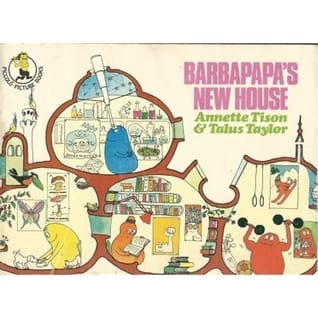
It only occurred to me as I was writing this that it is deeply and subconsciously inspired by one of my absolute favourite books when I was a child - Barbapapa's New House. Did you read it? It's the best. I can still feel my horror at the pollution and destruction and deep joy from the co-creation of the beautiful home of interbeing they make together.
* To emphasise - this is not to erase differences, but to think differently about difference. It is acknowledging the interdependence of our different forms. Separability slices through that interdependence and makes differences into walls.