"My theory of change is to be"
"It's more powerful than a legally binding agreement"
I have just had the immense privilege of spending the last week in the Yarra Valley on a Global Optimism Climate Leaders' Retreat led by Christiana Figueres - for six years the world's top climate negotiator as Executive Secretary of the United Nations Framework Convention on Climate Change - and the abbott and a dozen monastics from Plum Village - the Vietnamese Buddhist tradition founded by Thich Nhat Hanh.
I do not intend to attempt to explain what we did and learned.
That's partly because it feels a little impossible - one of the reasons the retreat was so beautiful for me was because it aligns so well with my increasing conviction that practice is so much more valuable than discourse. Much of what we did was simply ineffable, in the best way. The experience is what made it so. Which in itself is a key lesson. As the extraordinary Brother Phap Linh (Brother Spirit) put it:
"There is experience. That is all we truly know."
But also because it feels a little against the spirit of it. It's not quite as though "The first rule of Plum Village is you do not talk about Plum Village". But we all shared such vulnerability (led with such powerful openness by Christiana) that it would simply be wrong. And there is a clear strategy to invite people to take part without explaining what it's about, leading people into the experience itself.
For me, as someone who has never felt spiritual in any way other than through deep interconnection with and awe for the natural world or the transcendence of music, and who has for years tried to pick a careful path through the "mindfulness / self care is hyper-individualist and capitalist" vs "they're the only pathway towards true interdependence" minefield, the absence of preparation was, in fact, the best preparation. And I don't want to spoil that for any of my readers who might attend a later retreat.
All I will say is that there were beautiful bells and there was deep, rich silence. There was breathing and walking. There was laughter and singing and tears. And there was lots and lots of talking and listening.
Christiana opened the week with a welcome that set out what the retreat was not. In that vein, I preface this post by saying it is, as noted, not a summary or explanation. Neither is it an attempt to convince you that Buddhist practice is the solution to the climate and ecological and social and political crises (the retreat itself was clear that it does not make that claim). Neither is it a suggestion that you should adopt such practice - or even that I will.
What I do want - and need - to do is simply to write up some reflections on how what I experienced relates to my research - to my readings, of Hannah Arendt and of decolonial scholars and writing on ecological agency and on transformation as against transition, and to my evolving questions around how we situate ourselves in time, how we perceive our agency, and how we imagine and practice freedom.
And hooooooo is there a lot!
I suspect this may end up as something of a ramble through ideas that I need to put down in writing so I don't lose them, so I can continue to think about them, and so I can return to themes that emerge in the coming weeks and months and years. Bear with me, though, because I do think this stuff is really important.
It's not quite true to say I arrived at the retreat with no preparation.
One of the reasons I was so excited to accept the invitation was because I had long ago read some of Thich Nhat Hanh's work, especially on the concept of interbeing. This is a fundamentally ecological concept about the inter-relationship of everything, that obviously bears close similarities to Indigenous worldviews and practices of relationality, but also to Arendt's powerful concept of nonsovereignty - that none of us can make a claim to ever acting in the world in a way that is disconnected from the actions and responses of those around us. Having recently read Sharon Krause's fascinating new book, Eco-Emancipation, which beautifully extends Arendt's idea into the ecological, I knew this would be a crucial further extension.
Interbeing is an active concept, used as a verb - a verb that conjugates! I inter-am. We inter-are. This framing of us as human beings, beings who inter-be, has deep resonances for me with the decolonial writing of Vanessa Machado de Oliveira and Robin Wall Kimmerer, both of whom articulate the drastic implications of western noun-focussed language (what Oliveira describes as the "wording of the world") and Indigenous verb presence. It also echoes with Arendt's differentiation between acting / doing and fabricating / making in ways that still need to percolate in my mind for a while.
What bubbled up on the first or second day, as I knelt on my mat, breathing and listening, sitting with the pain in my spine (which released wonderfully about 48 hours in!), was how so many different traditions remind us to open ourselves to this interdependence, and it's really only western, modern, mechanistic civilisation that insists so fervently that we close ourselves off to it. When we peel back the modernism, let go of the separation, the interdependence is everywhere, and the pathways to rediscovering it are many and varied - and surely that's the point. One of the many things to let go of is the demand for a single, clear pathway to a single, clear outcome.
"My theory of change is to be", Christiana told us at about the midway point.
That chimed like a bell.
I was also vaguely aware of Thich Nhat Hanh's concept of Engaged Buddhism, developed as a young monk facing the reality of the Vietnam War and the questions of how to engage. His is a kind of "applied Buddhism", then, facing up to social and environmental issues, to war, to injustice. This leads to an active, interventionist practice of nonviolence, to participation in political movements for change, to mutual aid, to embracing the teaching of impermanence even reflexively on its own teachings, such as by celebrating same sex marriages. It is not abstract. Indeed, it challenges the idea of abstraction.
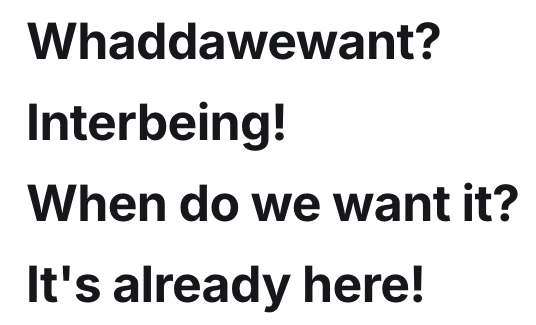
The cheeky chant above was my silly suggestion inspired by Brother Phap Linh's tongue-in-cheek idea of a new campaigning group - Abstraction Rebellion! He proposed this during a fabulous workshop on science and spirituality that he was eminently qualified to run, given he has a degree in pure maths from Cambridge and, by his own telling, grew up deeply abstracted from the world, cut off by the scientistic, mechanistic worldview, by the lessons of Richard Dawkins' Selfish Gene, by the "corrosive acid of reductivism". He eventually found that both spirituality and science (quantum physics, evolutionary biology) can lead us back to the recognition that interbeing is here, and always has been here, whether we embrace it or not.
This brings me to the reflections I wanted to make on the question of time, and how we situate ourselves in it, that I began to tease out here recently.
Brother Phap Huu, the young and energetic abbott, articulated the philosophy of impermanence that imbues the Plum Village practice poetically as follows:
"The past is no longer here, but it is still here. The future is not here yet, but it is already here. In this space everything is possible."
Mindfulness, in this engaged Buddhist sense, is a practice of "daring to be in the present moment", not closing our eyes to suffering, but truly developing the capacity to see it, to see reality as it is, here and now, and through this practice to transform it and ourselves.
Well, with Arendt's "facing up to and resisting of reality" in this "chasm between the no longer and the not yet" framing and guiding my thinking, how could this not speak to me?
There's a deep challenge to the idea of rectilinear time, the idea of progress, inherent in both ways of thinking. Equally, both embrace both the uncertainty and freedom of grappling with the present, of acting together, collectively, in the world as it actually is.
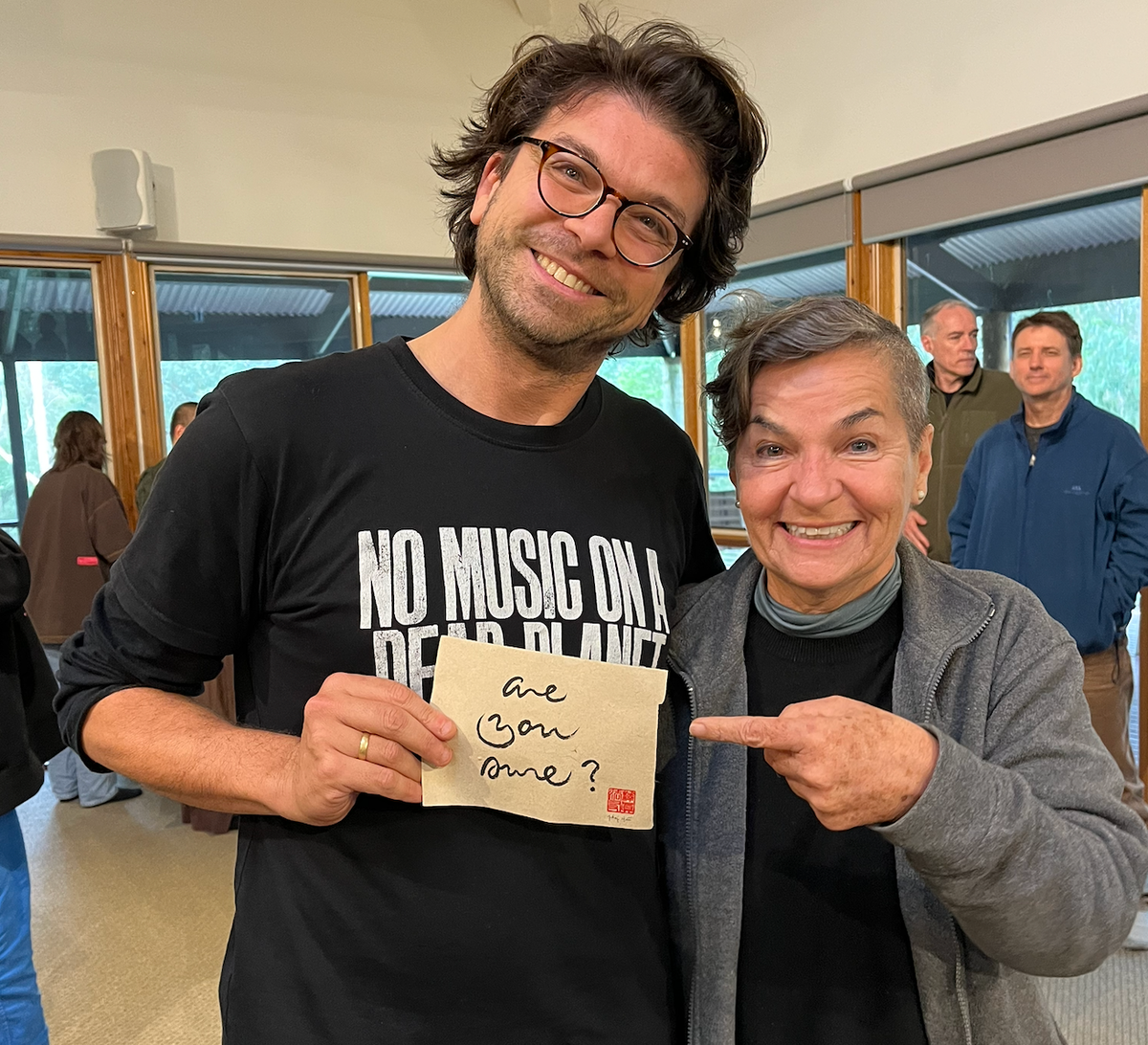
Christiana told an incredibly moving story about her process of letting go of the insistence upon certainty - the "we must therefore we will" - that climate rhetoric demands of us. It's counterintuitively incredibly disempowering to have to believe that what we're doing will work. At its worst, it can lead to dangerous "ends justify the means" assumptions, and can see us getting carried away by the flood of determinism that Arendt details in On Revolution. I can't and won't attempt to retell Christiana's story, which involved a Zen Buddhist repeatedly asking her "are you sure?", but I will quote her conclusion:
"I have slowly and painfully shifted my focus from the future to the here and now. This is where we have agency."
As we discussed around the dinner table, the future is a deeply scary place for climate-aware people to have our focus! We're either picturing catastrophe or a mad scramble to achieve targets or both. And in neither case do we have genuine agency. Nor do we find agency in autopilot campaigning, playing the role we've been given, as Arendt puts it.
But in mindfully bringing ourselves into the here and now, we can choose how to live together, and collectively walk the path that becomes our future with each step. And again, this feels like an unexpectedly beautiful weaving of Arendt and Plum Village.
Brother Chan Troi Bao Tang (Brother Treasure) worked through with us how a true mindfulness practice (as distinct from its capitalist coopted version, as Brother Phap Huu was at pains to point out several times) takes us out of autopilot mode, by bringing our attention to the repetition, to the habit, in order to transform it. In autopilot, Brother Treasure articulated, we lose our freedom.
Engaged Buddhism, mindfully bringing our attention to the present, then, is a liberatory practice!
As Brother Phap Huu put it, "For change, there needs to be a letting go. And in that moment we are most alive, most free."
And what a clear resonance with Arendt's concept that freedom is to be found in acting, collectively, "in concert", in this space between past and future, liberated from the "no longer" which constrains our possibility to act into the "not yet".
Similarly, where, for Plum Village, there is a liberatory aspect to embracing interbeing, dropping the need to act as individuals with certainty about our ability to control the future, for Arendt freedom can never be an individual pursuit - it only finds meaning in "acting in concert" with others, in interplay with the world.
In this way, we begin to redefine agency. We begin to see our capacity to act in quite a different light - not in playing our given role in abstracted decision-making that changes nothing, but in embodied practices that change our relationship with the world.
We tend to pay attention to what we do, but not how. But it's the how that resonates and radiates through the world. The how actually is the what.
As Brother Phap Linh led us to see, there's a different path here for building a community of resistance.
An abstraction rebellion.
A letting go of the illusion of individuality, the pretence of permanence, the nonsense of separability.
A letting go of the illusion of control: "Are you sure?"
The theory of change is to be. And to be is to interbe.
And if we can radiate that through the world, as Christiana Figueres - the chief negotiator of the Paris Agreement - told us, it is "more powerful than a legally binding agreement".