The pursuit of happiness?

They've all come to look for America
"Kathy, I'm lost", I said, though I knew she was sleeping
I'm empty and aching and I don't know why
What do you get for the Empire that has everything, on its 250th birthday?
And why does Paul Simon's lyric "I'm empty and aching and I don't know why" feel so incredibly apt to describe America as an entity, both today and historically?
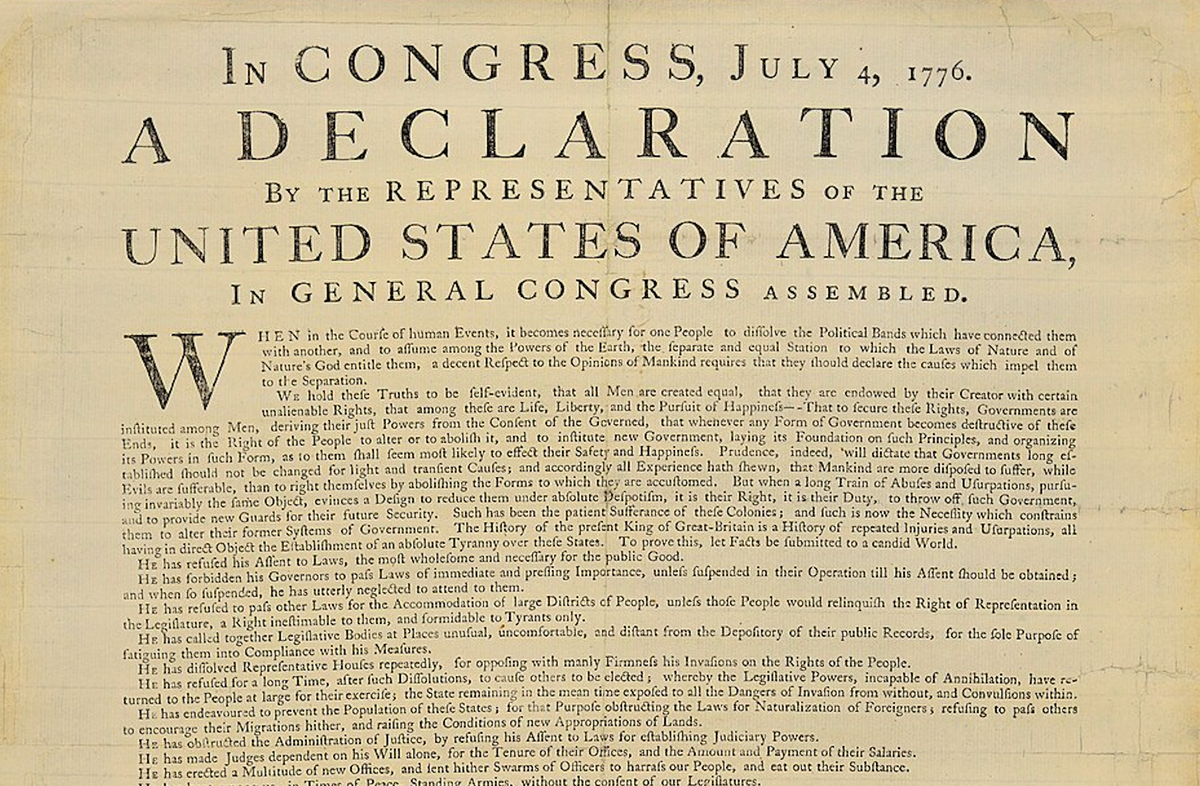
If there's one phrase from the Declaration of Independence which captures this, surely it's that among the "unalienable rights" the Founding Fathers believed to be "self-evident" is "the pursuit of happiness".
The pursuit of happiness!
What a concept!
Why would a bunch of well-to-do white men in 1776 insert that oddly yearning phrase alongside life and liberty?
And how has its shifting meaning mapped against the shifting meaning of America, and of the "American Dream"?
And what might it tell us about what to do today, as we find our way together between the no longer and the not yet?
As usual, Hannah Arendt helps us to think about it.
In her 1963 book, On Revolution, Arendt dedicates a chapter to the phrase. She proposes that its original intended meaning encapsulates what she sees as the American Revolution's unique success, but the ambiguity of its framing opens the door to the tragedy she already foresaw as possible.
The book analyses the different philosophical and experiential approaches of the French and American Revolutions, bringing their lessons through the 19th and into the 20th Century, examining how their meanings echo through the Russian Revolution and the 1956 Hungarian Uprising. Across the book, she draws out a series of explanations for why America succeeded in creating a genuinely new and lasting republic, while France spent a century swinging wildly, and Russia plunged into totalitarianism.
[As a Jewish refugee from Europe to America, she is at times perhaps overly generous to her adoptive home, especially in recognising but insufficiently examining the factor of America's revolution being a wealthy white colonial and slave-owning affair. But I was pleased to read recently in Marilyn Nissim-Sabat and Neil Roberts' amazing Creolizing Hannah Arendt that they, like me, "believe that if Arendt were alive today, she would be just as trenchant and uncompromising in exposing the flaws in the American Constitution and contemporary American political life as she was in exposing the flaws of all previous forms of government." (p4)]
Perhaps the central difference between the French and American Revolutions, for Arendt, is that in America, as she quotes John Adams, "‘the revolution was effected before the war commenced’" (p118) because the American colonisers already had deep experience of self-governance, through town hall meetings and public assemblies. This was part necessity, in being far from Britain, part an inheritance from democratising religions like Quakerism, and indeed part inheritance from First Nations governance systems they came into contact with.
Which brings us to happiness:
“What was a passion and a ‘taste’ in France clearly was an experience in America, and the American usage which, especially in the eighteenth century, spoke of ‘public happiness’, where the French spoke of ‘public freedom’, suggests this difference quite appropriately. The point is that the Americans knew that public freedom consisted in having a share in public business, and that the activities connected with this business by no means constituted a burden but gave those who discharged them in public a feeling of happiness they could acquire nowhere else. … [T]he people went to the town assemblies … [not only out of duty or personal interest] but most of all because they enjoyed the discussions, the deliberations, and the making of decisions.” (On Revolution, p119)
It is this form of happiness - public happiness through active civic participation, which also brings personal happiness because it's genuinely fun and fulfilling - which Arendt argues is the original intended meaning of the phrase in the Declaration of Independence. And it is the experience of this public happiness - democratic practice and skills more than simply democratic or social ideals - that became what Arendt calls the "revolutionary spirit" imbuing the process, enabling it to last. It's the beating heart of the republicanism (the political philosophy, not the party) they sought to institute - a philosophical commitment to popular sovereignty, non-domination, and civic participation.
This public happiness is very different from private happiness, or simple personal interest. Indeed, the pursuit of personal interest, of private happiness, without regard to the collective happiness of those around you, is the poison in the well of genuine republicanism. Arendt, with her wonderful concept of "non-sovereignty", wrote consistently of the disasters which follow the attempt to act as a sovereign individual (or state), believing yourself independent of those around you, free of consequences. Private happiness, for her, can only be real and lasting if it is embedded within public happiness.
When it came to drafting the Declaration, Arendt points the finger at Thomas Jefferson for inserting "the pursuit of happiness" instead of "public happiness", a choice of language which “blurred the distinction” (p126) between public and private happiness. This fateful choice, she writes, “was to contribute more than anything else to a specifically American ideology, to the terrible misunderstanding” (p128) of later generations, who had lost the experience of public happiness, lost the "manyness" (p93) of public life, and understood only individual personal happiness.
The error is compounded through the Constitution. Arendt celebrates the remarkable achievement of successfully instituting republican ideals of non-domination through confederation, separation of powers, the system of checks and balances which prevented (until recently) any branch of government from dominating the others. But the Constitution left the popular assemblies, the town hall meetings, out of the institutional formations, abandoning true popular sovereignty and civic participation.
This was not as immediately catastrophic an error as Lenin's direct and violent liquidation of the soviets (the participatory councils which sprang up during the revolution, as they spring up in every uprising including, to Arendt's obvious delight, the Hungarian Uprising of just a few years earlier) but it leads inexorably to the collapse of the public arena, the public good, and public happiness.
It's worth also briefly looking at the other part of the fascinating phrase - the word pursuit.
Arendt is all about temporality - origins, between past and future, dark times... She is always thinking about how actions lead from one to the next, how the past drives us forwards or ties us back, how the future captures us or pushes us back, how freedom exists in the now. This is why she lights on Adams' remark that the American Revolution was "effected before the war commenced". Past experience meeting present disruption creates the possibility of something new emerging.
This is in stark contrast to the French experience, where extreme poverty, extreme wealth, and disastrous misgovernment unleashed destructive violence, unleashed rage without anywhere to go, without the lived experience of an alternative. The French Revolutionaries, Arendt writes, were swept away by the torrent they let loose, and countless revolutionaries ever since have similarly leapt into the flood, believing in the "irresistible process" (p49) of the tide of history to carry them into the future.
Arendt calls bullshit on this. She tears these revolutionaries a new one for abandoning their true agency. History is not an irresistible process. It is actions in the now. It is what we choose to do together, acting in concert, living our collective freedom to choose our path.
Arendt doesn't explicitly say this, but, in this analysis, the word pursuit also becomes problematic, particularly in these times "between the no longer and the not yet" when systems of power and authority are "in plain disintegration" (p116). Pursuing happiness sets it in a future we need to achieve, and therefore can use any means to achieve that end. This, it seems to me, is especially so if it is private happiness that is being pursued. Personal interests can be pursued as ends which justify the means. But, for public happiness, the means are the ends. Public happiness is something you can only live in the now.
Which leaves us with the question: what do we do with this idea (in the) now?
Can cultivating public happiness be a genuinely revolutionary path, here in the in between, as the USA celebrates its 250th anniversary with a mad king on the throne and parades cancelled due to extreme heat driven by the pursuit of private happiness?
I have to answer yes. And I answer it loudly. Again and again. Because I don't know if your algorithm has also recently been serving you the current trend of social media videos making fun of how "every leftist book ends with mutual aid and talking to our neighbours hahaha how silly".
But, well, yeah. That's the work. That's the revolution.
The revolution will not be televised, because actually it's mostly about doing the washing up and stacking the chairs after the meeting and sitting with the person who had a hard time and working through the discomfort of disagreement about things that really matter (and sometimes things that feel like they don't matter at all) and negotiating agendas and distributing food and checking in on neighbours.
The revolution is learning the skills of living together well. The rest is noise.
It's unglamorous, but it's joyful. It's far from heroic but it's full of power and agency.
It's the revolution that happens before shit completely falls apart, so we're ready, when it does, for the new world to emerge.
--
I'm empty and aching and I don't know why
Counting the cars on the New Jersey Turnpike
They've all come to look for America
All come to look for America
All come to look for America
--
PS: In my pursuit of happiness - both public and private - I quit my job last year and started a PhD to investigate what on Earth we do with ourselves in this chasm between the no longer and the not yet. So... if you have the capacity to chip in as a paid subscriber, it would really make a difference.
And I'd be so grateful if you could spread the word by forwarding this email, or previous ones you may have particularly enjoyed, to people who might find it interesting and helpful, as we puzzle our way together through these in between days. I love using Ghost, as a more ethical alternative to Sobstack, but it does make it harder to grow a readership.
Thanks for reading!