On mushrooms, death, transformation... and Epstein


Wonderings on the echoing implications of our relationship with death
When I die, compost me.
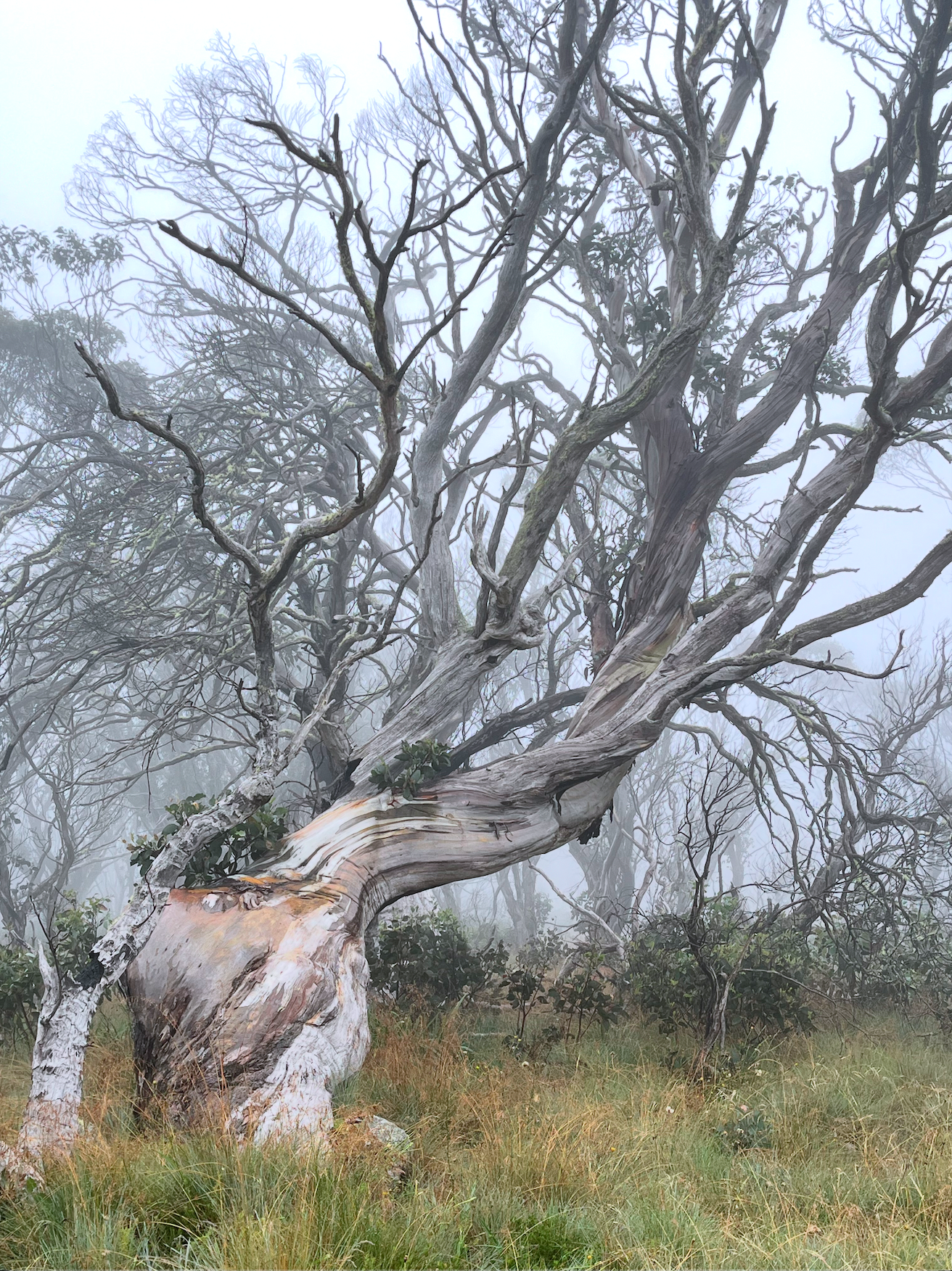
Put me under a tree - a snow gum, if possible - and let it feed.
Let the mushrooms and their mycelia unmake me into morsels, into molecules becoming free to become something otherwise.
Consider this a trigger warning.
Breathe in. Breathe out. Repeat.
Here's a tree.
I've been thinking about death again.
One of my parents' oldest friends, a beautiful soul, Larry Boyd, died recently. Though I'd rarely seen him for years, his passing made a big impact on me. It viscerally brought back his presence in my childhood - the way he showed a gentle masculinity which, in retrospect, was deeply formative.
Then the brilliant Jon Kudelka, who I was lucky to be online-friends with, died far too young, fighting desperately against the brain cancer tearing him from his family.
And we recently marked a decade since my beloved Oma, who taught me so very much about moving through the world with love, no matter what it throws at you, left us.
They're gone. But they're still with us.
Parts of them are part of me. And of so many others.
These thoughts were rattling through me when, the other day, I went for a walk listening to the mellifluous mycologist, Merlin Sheldrake*, interviewed on the Emergence Magazine podcast. He talked, in his soothing tones, about mushrooms as unmakers, decomposers - a role central to life, to creating, to making.
"Composers make; decomposers unmake. And unless decomposers unmake, there isn’t anything that composers can make with."
"And in unmaking, of course, you are actually making as well."
He set this mycelial masterclass in impermanence against the mythologies of permanence - the "fantasies of immortality" - that run through modernity.
This is one of the key themes of my book, Living Democracy, as well. I identify the pretence of permanence as one of the three defining features of anti-ecological political culture, alongside separation and domination, pointing to Margaret Thatcher's "there is no alternative", business calls for "certainty", as well as our general reluctance to embrace transformative change.
Indeed, the topic of the doctoral research I'm diving into springs from my experiences talking about this during my book tours. I wasn't quite prepared for the extent to which my observation that embracing the new requires letting go of the old would challenge readers. The idea of withdrawing our consent from destructive, crumbling systems apparently terrifies us.
I'm far from the first to speculate that this may be connected to our culture's pathological fear of death. It's not that other cultures like death. But most are better at recognising it as a natural part of life, and at establishing rituals and practices that help guide us through, bringing the reality of death into the ways we live. Whereas mainstream modern culture hides it away, pretends it can avoided, uses euphemisms and passive voice to distance ourselves discursively and superfoods and cryogenics to stave it off physically.
Anyway, here I was, walking, listening, breathing, with these thoughts about death and letting go bouncing around my synapses, when they hit some weird connection and I stopped.
I've been avoiding thinking about Epstein.
My deeply engaged 19 and 21 year old kids read about it obsessively, feeling they need to bear witness. And they tell me about it. But I use every trick in my book to not actually contemplate it. I can't bear the thought.
I have gone so far as to check some stories on Snopes, which says that, while stories of actual sacrifices and cannibalism do appear in the files, they remain individual unverified claims, not demonstrated fact.
That's one of my tricks.
Another trick has been to intellectualise it in the context of the death-dealing and abuse that is inherent in the capitalist liberal democracies that these despicable men are "leaders" in. Yes, the impact on Epstein's victims and their families is utterly horrific to contemplate. And we must also contemplate the awfulness of the impact of for-profit health care, and approving coal mines, and financialised housing, and punitive welfare, and weapons trading for fucks sake. The scale of the deliberate deaths of individual humans in their countless millions, the deliberate immiseration, driving people to suicide, starving people to death...
We are called to bear witness, to not turn away. And yet, we truly cannot bear witness to it all, or we will be paralysed.
But it strikes me that there's a thread here that hasn't been pulled on (noting my deliberately limited observation).
Yes, patriarchy, and the appalling behaviour of men, is at the heart. And yes, the entitlement of the super powerful (the factor that sets Epstein aside from the gut-wrenching abuse Gisèle Pelicot was subjected to) is central. In both cases, the belief - of men, of powerful men - that they can do what they like without consequence, is clearly a defining feature. I am in no way attempting to detract from those factors.
And... isn't there also something here about our culture's pathologies around death? The active participation of these men in the death-dealing capitalist system. Their desire to live without consequences and their desire to cheat death and their knowledge that they can do neither. Their (subconscious, mostly denied) knowledge that their actions, their financial dealings, their legislative and executive decisions, cause death and misery and destruction. Have they become so desensitised that they need to do the most awful things to feel something? Is that psychological injury what drives them to directly abuse children?
The Cameroonian post-colonial scholar, Achille Mbembe, coined the term necropolitics to describe how colonial and class power create worlds in which whole populations are relegated to the status of living dead. Their lives simply do not matter. Their deaths don't count. Necropolitics is clear in slavery and in war. In Gaza, necropolitics is stark. Necropolitics is there in the targeted violent policing of Aboriginal people in Australia. It is there in the dehumanising political targeting of trans people. It applies through Robodebt - deliberate disregard for the lives of the class of people relying on welfare, driving people to suicide. And all future lives are subjects of necropolitics through the continued use of fossil fuels, the clear-felling of forests, the rape of Mother Earth, the wilful destruction of everything that makes life possible.
The mushroom unmakes in order to make. This is the opposite - an unmaking which leads only to more unmaking. Which makes one feel that only unmaking is real. Only unmaking is possible.
Surely, this is a factor in the Epstein horror.
And... deep breath... I want to say elements of it are in all of us. We're all damaged by our death-dealing / death-defying culture. If we can't recognise the intertwined nature of making and unmaking, is it any wonder that some are attracted to violent revolution, that some shut down and narrow their scope of view to the here and now, that so many struggle to believe that another world is possible largely because that would mean letting go of this world?
Bringing it back to the thrust of this blogletter (if you're new here, please read this)...
I think there's something here about the difference between Gramsci's old world dying and new struggling to be born and Arendt's chasm between the no longer and the not yet.
What if, in the context of our morbid culture, the dying metaphor is too final?
In On Revolution, Arendt writes of reconstituting elements of power in a way I find very reminiscent (pre-reminiscent? preminiscent?) of Sheldrake's decomposition / composition cycle, recognising that we can't make anything unless we unmake to make the constituent parts available. In Between Past and Future, she articulates how the no longer remains with us. Adding the ecological metaphor, we compost it, sift through its constituent elements, find what we want to keep and what we want to leave behind, and we grow the new from the healthy soil.
And, in On Violence, she names the fact that "all institutions of power petrify and decay as soon as the living power of the people ceases to uphold them."
This is where we are. A long, slow moment of petrification and decay. Pretty much every institution I see finds itself here.
Is there mushroom for hope?
Only if we connect the unmaking to the making.
* If you haven't read Sheldrake's book, Entangled Life, just do, ok?