Movements in time between Progress and Degrowth

On seeking direction in a directionless world
Moments in time. Movement in time. Movements in time.
As we spun past the autumn equinox, the darkness lasting noticeably longer each morning and edging closer each evening, the burst of winter weather turning the screws on my arthritic joints, I spent much of the last week in Naarm / Melbourne, participating in two radically different political gatherings - Degrowth Fest and Progress 2026 - slipping away frequently from both to continue my deep dive into Hannah Arendt's writings.
Attending these events while reading On Revolution, having just re-read Between Past and Future, focussed my mind on time - on how we perceive and present our place and direction in time - in interesting and challenging ways.
Progress - a broad gathering of "progressive" movement organisations and organisers held at a big, modern convention centre - sees itself at the leading edge of the tide of history, confidently preparing the path for the irresistible sweep of what Arendt calls "history as process".
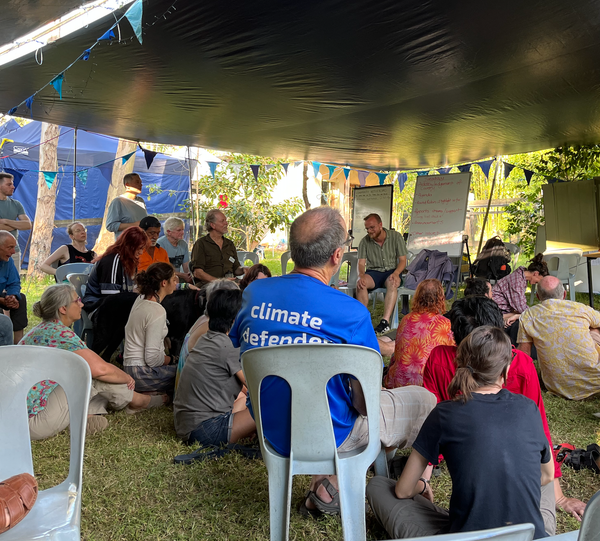
Degrowth - a gentle, lovingly disorganised picnic in a park - seems slightly uneasy with its direction of return, wanting not to be retrograde while distributing zines, upcycling clothes, and avoiding tech.
One points confidently forward. One looks uncertainly back. Both float like dumplings in a soup of the eternal present, in a society alienated from both past and future and unable to imagine a different world.
Feeling comfortably divested of the expectations that come with being employed in the space, going along mostly to see old friends and, cheekily, as something of an ethnographic study, I was actually able to have a genuinely delightful time at both events. If what I write here feels critical, it is truly critique with love. I have so much gratitude and respect for everyone stepping up for the greater good, and particularly for my dear friends (shout out Anisa and Kirsty) whose incredible efforts made Degrowth Fest and Progress 2026 vibrant successes. From my one step remove, studying these movement spaces as a path to support them better, I feel more able to appreciate divergent efforts without griping than I have for quite some time. There's something about admitting that you don't have answers, but are genuinely asking questions, that I think Arendt calls us to do, that simply opens up creative space, space in which to be free. Hopefully my questions can open that space to others to find their way in as well at this time of confusion.
Time, its flow, and our place and directionality in it, seems to me to be one of the major themes of Arendt's work.
Early in Between Past and Future, she retells a parable of Franz Kafka's, of a man walking a path, driven forward by the past, pushed backwards by the future, staggering in the always-and-never present, wishing himself able to step outside the flood and observe, but never able to do so.
This "gap" between past and future is our constant reality and, of course, a pretty basic concept. But there are three important observations Arendt makes which transform it into something sophisticated and challenging.
One is that this parable inverts our usual narrative that the past anchors us and the future drags us forwards. Here, we are propelled forwards by our past and find the future holding us back. There's something here that I want to come back to about how, in this political moment, we have an interesting inversion going on, with progressive nostalgia and transgressive conservatism, that has us quite confused.
The second, and the one regular readers of this blogletter will now be familiar with, is that sometimes this "gap" actually becomes a chasm, not simply between past and future, but between no longer and not yet. There are times, after so many experiences of alienation, inversions of traditional worldviews, clashes between story and reality, collapse of the authority of governing systems, when we lose the propulsive power of the past and find ourselves adrift, unable to perceive the future and thus, if we are willing, able to step into our true freedom to create something genuinely new.
In one of the many neat contradictions that characterise Arendtian thought, she proposes that these moments when freedom and creativity become possible are unusual... and also common? What I think I am coming to understand from this is that they are often possible but rarely acted on - or even, it is rarely understood that they exist. In On Revolution, she extends this concept, articulating that revolutions can only happen when governing systems have already lost their authority, but don't always happen when that is the case.
"On the contrary, the curious and sometimes even weird longevity of obsolete bodies politic is a matter of historical record" (On Revolution, p116).
What's going on in these weirdly long-lasting unusual spaces of political obsolescence is that we hold on. Long after we've lost the thread, we keep holding on. Indeed, we hold on even tighter, because we're uncomfortable admitting that the thread we think we're grasping is no longer attached at the other end.
"The end of a tradition does not necessarily mean that traditional concepts have lost their power over the minds of men. On the contrary, it sometimes seems that this power of well-worn notions and categories becomes more tyrannical as the tradition loses its living force and as the memory of its beginning recedes; it may even reveal its full coercive force only after its end has come and men no longer even rebel against it." (Between Past and Future, p26)
This, I think, is the crux of my analysis, where I believe we find ourselves now, and the starting point for my PhD research. We can't forge a path into the not yet until we have acknowledged that the no longer is no longer and become willing to think and act in this reality.
At both Progress and Degrowth Fest there were countless conversations about how what we've been doing to make change simply doesn't work anymore. The institutions and traditions and norms that we've been taught to rely on are broken (recognising that they only ever worked for a given meaning of 'worked'). The rise of fascism and the arrival of AI further shake the foundations of a world where government (executive and bureaucratic) and business no longer respond to movement power in ways we had previously experienced them to (sometimes) do.
At Degrowth Fest, the vibe was a bit "stop the world, I wanna get off!" Which I respect. I'm there, myself. But it often becomes a fatalistic "living well together in the decline", rather than seizing a moment in which it might become possible to cultivate new collective power. And when it does think about power, it often falls into prior assumptions about elections and political parties, or about performatively remaining on the margins.
At Progress, the "this-doesn't-work-anymore" conversations frequently diverted straight back to "well, we'd better try harder, then!" What campaigning and organising skills can we learn from each other? What examples of success can we replicate? Notably (and I won't reveal names, out of genuine love and respect and support), even where strategies were presented in terms of "creating the conditions for new political possibilities to emerge", the tactics flipped immediately back towards defending existing wins at upcoming elections.
We're seeking direction in a directionless world.
In this unmoored ever-present, we've lost the propulsive power of the no longer but keep grasping for it, instead of cultivating our own not yet.
Which brings me to the third layer of that Kafka parable that Arendt peels back: stepping outside the flow of time to observe history. She explores this conceptually in Between Past and Future, but in On Revolution it becomes material through her retelling of the 18th century revolutions and those that followed them.
When the gap between past and future becomes a chasm, it becomes possible simply to act, to step into the freedom we humans always have available to us to come together to act in concert and create something new. Arendt references the Levellers in 17th century England, and the pre-revolutionary Americans, establishing new commonwealths, non-state "bodies politic", creating the possibility for the American Revolution to constitute a confederation of balanced powers which has been able to last, imperfectly but improbably, for so long. [Fascinatingly, she foreshadows, back in the early 1960s, the possibility of the hyper-individualist pursuit of happiness through personal wealth being the key threat to its survival! More on that soon in another post I'm working on about freedom and the pursuit of happiness.]
It is also possible, in this chasm, to get carried away with destructive forces and be unable to create any lasting form of power, resorting instead to repeating and intensifying violence, as happened in the French Revolution. With no successful claim to new power through genuinely "acting in concert" at the grassroots, coercion became the tool of choice, and failed over and again to "give birth to power" (On Revolution, p181). She has a lovely snide line about resorting to writing constitution after constitution because they could grasp no actual power.
In both cases, interestingly, the revolutionaries started, Arendt says, by looking backwards, seeking "renovation", "return" to a perhaps imagined, certainly idealised past, and only almost accidentally finding themselves on a new path. America was able to forge a creative path, in no small part because it compartmentalised the misery of colonialism and slavery, while France unleashed the full misery of Old World poverty without having the active, practical experience of "acting in concert" that the New World colonists had. Both found themselves propelled by the tides of history, the meaning of revolution shifting from a "re-turn" into the "irresistible turning" of the earth and stars and tides.
And that leads to the third possibility in this moment: to step outside and observe history. This is what Arendt says Marx and other 19th century observers of 18th century revolutions do, and it leads, she says, to the dangerous new idea of "rectilinear time", of "history as process", of historical determinism.
If the original revolutionaries simply acted - beginning with an attempted return, but finding themselves propelled forwards - those who followed saw themselves as "agents of history and historical necessity" (On Revolution, p52), learning not from the actions of revolutionaries but from the historically determined path they believe the revolutionaries followed.
"Those who went into the school of revolution learned and knew beforehand the course a revolution must take. ... What the men of the Russian Revolution had learned from the French Revolution... was history and not action. They had acquired the skill to play whatever part the great drama of history was going to assign them". [On Revolution, p57-58]
For Arendt, if I'm reading her right, history isn't a process - it's a succession of moments in which people and groups are able to step into their freedom and create something new together, followed by periods of slow petrification and decay of this new entity, punctuated by various responses and inversions which perhaps extend its life while taking it further from its initial creation, before it is eventually replaced in another burst of freedom.*
A crucial point here, for our purposes, is that Arendt doesn't believe in the idea of progress. The view of history's arc bending towards justice is, I think, to her, certainly alien, perhaps naive, possibly problematic, in that it keeps us so busy working for liberation that we forget to simply be free.** And this, she points out, all too frequently leads either to catastrophe or to laziness.
This is particularly important for Progress. Kind of obviously. If history doesn't simply move along a rectilinear path, "being on the right side of history" becomes meaningless, and efforts to drive it forward with appeals to progress could keep us focussed on process instead of action, on trying to liberate ourselves within the no longer rather than acting as if we were free to create the not yet together.
One of the most challenging aspects of this is encapsulated in Arendt's comment, at the end of the quote above, about playing the part history assigns us. This is a concept that often resonates strongly with activists when I raise it - it seems we often feel like, in our activism, we're simply performing a role we've been allocated, and which we don't know how to step out of.
This is a necessarily brief glance (given how long this post has already become) at an idea that needs some deep excavation, around movement personas, activist personas, the role of movements in society, acting in ways which the system needs, which the system allocates to us, in order to extend its own (crumbling) legitimacy. Arendt goes much deeper into these ideas, and I'm definitely going to return to them, but at this stage simply want to note its relevance to the way our movements see and present themselves in relation to time - not only for Progress but also for Degrowth, which can also be susceptible to playing a given role, in that latter case usually comfortably on the margins.
In closing, for now, though, I want to return briefly to this slightly contradictory phenomenon of progressive nostalgia.
In an unmoored world where the populist right is being explicitly, almost gleefully transgressive, tossing fuel on the bonfire of institutions and norms, the left finds itself, while talking about progress, often defending those institutions and norms, defending an imagined past which no longer exists (to the extent it ever did).
With all of us floundering in this "weird longevity of obsolete bodies politic", seeking direction in a directionless world, Pauline Hanson, Trump, Farage and co are able to lean in to that feeling of being adrift, while we feel we have to hold on. It's another aspect of what I explored in this recent post about populism, and how right populism has an easier task than left populism.
If Arendt is right, and the revolutionaries of the 18th century started off by harking back to an imagined and idealised past but, in so doing, opened a pathway to creating something new, my question is, will we unleash the forces of destruction in a world of intersecting crises, or can we actually learn to be free together? Can we step into that uniquely human capacity to "act in concert", and cultivate a not yet in which we can all thrive?
I am sure we can. But it's going to take the courage to let go of the no longer.
* This is a counterpoint to her friend, Walter Benjamin's, Angelus Novus - the angel of history, blown ever backwards into the future, staring wide-eyed and open-mouthed at the past as catastrophe upon catastrophe piles up, unable to turn away or do anything about it. I'm footnoting this here because I want to come back to it at some point soon and tease out the similarities and differences between these two European Jews fleeing the holocaust, walking the same path (which my partner and I followed in homage last year) across the Pyrenees into Spain, Benjamin then taking his own life in fear while Arendt lived another 34 years, able to reflect on her dreadful experiences with remarkable optimism and love of the world.
** NB, while I think this is how she would view that phrase, this does not imply at all that Arendt did not tremendously admire Martin Luther King Jr. She was hugely inspired by his actions, and I plan to do a deep dive into her essay on Civil Disobedience here soon.