Discomfiting heat


On sitting in discomfort or seeking simple solutions
It's hot.
It's hard to think when the heat is so intense.
And we need to think. We need to think through some painfully hot challenges. Challenges to which there are no simple solutions, no shortcuts.
And the temperature is rising - politically, socially and ecologically.
 Sophie Lewis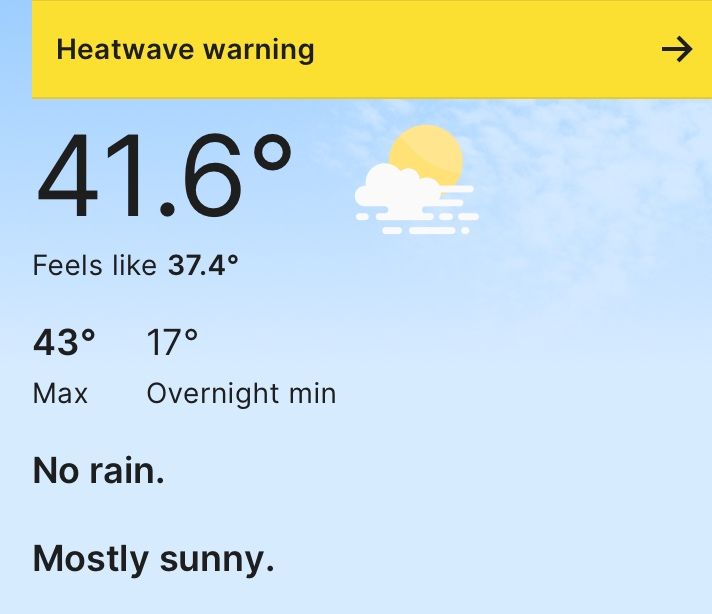
My friend, Sophie Lewis - an IPCC lead author - sets out the trend in days above 40C in Canberra
Late this morning, after running a few errands, I walked home in heat that was rising through body temperature towards another >40C peak - a peak that used to be incredibly rare here but is becoming a regular summer event. Coming through the door, I guzzled a couple of glasses of water and then stepped into a cold shower.
If only there were obvious and straightforward ways through the political heat so we didn't have to sit in the discomfort.
But, in politics, as in all forms of interpersonal interactions, sitting in the discomfort is necessary. It's how we work through it.
The first time I truly got that point was when I read Vanessa Machado de Oliveira's extraordinary Hospicing Modernity. There's so much depth to that book that I can't do justice to and won't attempt to, but one theme running throughout is that we need to do the work of being uncomfortable, listening to what is making us uncomfortable, holding ourselves and each other in that uncomfortable space, holding ourselves and each other in care and in accountability, so we can find a path from there.
It's another view into Arendt's chasm between the no longer and the not yet, where we have to do the hard and uncomfortable work of facing up to and resisting of reality that is the heart of this blogletter. It's a view that I think brings added nuance and depth - especially that crucial combination of collective care and accountability.
I'm tiptoeing around something here. Time to step into the discomfort.
Last night there was a very uncomfortable meeting of the ACT Greens. A very uncomfortable meeting precipitated by some very uncomfortable actions that came, I think, from having to sit in some genuine discomfort and, as is human nature, looking for a shortcut out of it. I'm going to be careful here, for reasons of confidentiality*, and because I have a lot of love and sympathy for the people involved and the political project, despite having lost my belief that it has the answers we need while it remains embedded in an utterly broken system. But there are questions here that need to be worked through.
Canberra is a wonderfully progressive town. The ACT has the best electoral system going. With Greens having shared government with Labor in various permutations for 12 years until stepping onto the crossbench after the October 2024 election, we've achieved some remarkable things - 100% renewable electricity, raising the minimum age of criminal responsibility, pill testing, the country's most humanely balanced response to Covid, the beginnings of a gas phase out, and so much more.
But there is a lot that is very broken.
It's not just run-down schools and hospitals and budget blow-outs. It's not just the bizarrely stalled light rail roll-out and the failure to start work on the next phase of the climate strategy. It's not just the ongoing investigations into actual corruption and the parade of Ministers who seem, to my eyes and many others', blithely incompetent and uninterested. The system is sclerotic. Things that should happen don't. Great policies are announced and don't get implemented, or get implemented poorly.
In this context, a little over a year after choosing to move to the crossbench to try to hold Labor accountable in a different way, the ACT Greens party room opened a conversation with the Canberra Liberals about turfing out Labor and sharing government for the remainder of the term. They did this without preparing the ground, and without engaging with the party's membership. I was part of a small group of members who were briefed on this and who immediately advised that it be halted, both on process and political grounds.
Let me just say - it's hot.
It's really fucking hot.
And not just because we've hit 40C here in the leafy inner suburbs of Canberra.
It's true that this is a government that doesn't deserve to be in government. It's true that the efforts to hold them to account don't seem to be working. It's true that they are ignoring motions passed on the floor of the Assembly. I can completely understand why the Greens MLAs are so incredibly frustrated and are looking for options.
But this, to me and to the vast majority of members who turned out in droves to last night's meeting, is an example of H.L. Mencken's adage that "For every complex problem there is an answer that is clear, simple, and wrong."
If, to a hammer, everything looks like a nail, what we have here is a parliamentary team who see only parliamentary maths as a pathway, forgetting the vital need for community campaigning and grassroots democratic engagement. What we have here is a team in a small, local assembly seeing only the immediate local politics, and not recognising how fundamentally intertwined we are with national and global politics. What we have a team of policy wonks hoping to achieve specific outcomes and not seeing the impact on the broader political culture.
While party members would love to see policy outcomes, most are appalled at the idea of putting a bunch of people they (I think reasonably) perceive as climate-denying, homophobic, racist, ultra-capitalist culture warriors into power, especially at a moment when the Liberal party is in national disarray. While members agree that Labor is somewhere between a mess and a debacle, most cannot see how the Liberals would not be worse. While members want to see politics done differently, they see this as same-old power politics that would only deliver a swag of seats to Independents next election.
I also want to be clear that I don't know what the solution here is.
But I am sure that, as I told the party room, if taking a particular path means going against our fundamental ethics and principles, especially about grassroots decision-making, it's a path we should not take.
And I am sure that, rather than seeking a shortcut to executive power, we have to sit in the discomfort, listening to what the discomfort is telling us, holding each other and ourselves in that discomfort, in both care and accountability, to seek a pathway.
Among the many members who are appalled by this action, there are other responses circulating that I also see as "clear, simple and wrong", whether it be "be more Mamdani" or "never do x". There is such a tendency in politics to seek these simple, shortcut solutions.
Where I have reached, personally, is that the problem is inherent in the structures and norms of our politics. I don't think there is an answer for the ACT Greens. Or, for that matter, for the Greens nationally, where they are stuck between a rock and hard place, as I explored a bit here about having to be either blockers or ineffectual or both. They are trying to do something that the system is built not to do. The party needs to think very deeply about its role in a sclerotic system in a world on fire.
That's a big part of the reason why I've stepped right back from politics to do some research. (Also, ten years at the Green Institute, adding up to over 20 years in active Greens politics, was too long for me. Hashtag just saying.)
The discomfort is huge. It can't be avoided. There are no shortcuts.
To end on something more positive, at the same time as all of this has been going on, I've been hugely privileged to be part of some deep discussions in Rising Tide about strategies and pathways.
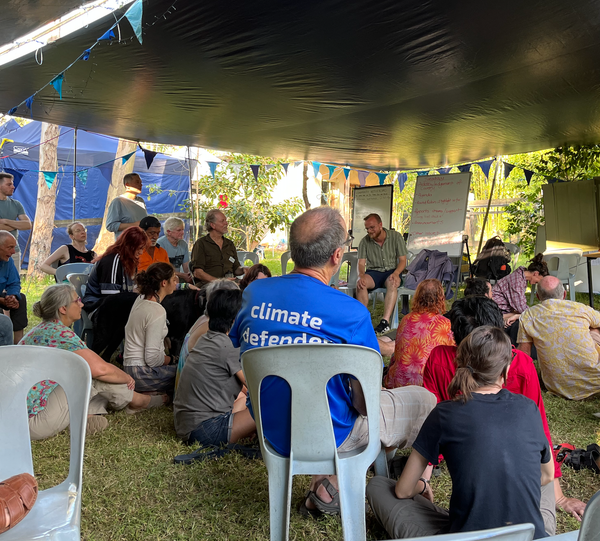
While of course not perfect - nothing is or should pretend to be (or perhaps even strive to be?) - it's been wonderful how much Rising Tiders have been willing to sit in discomfort. The conversations, as large groups and small, overlapping and cross-fertilising, have gone deep, challenging assumptions, questioning the core of strategy, demonstrating trust and creating accountability by inviting participation, and holding each other in real care as we sit together in this discomfort.
Do we have answers? I'm not sure we do, to be honest. But we have genuine questions. And I am more confident that pathways will emerge that are worth exploring.
Time to take another cold shower.
* The confidentiality here is both out of respect for the challenges of the political process and because I was invited to take part in an advisory group around this for which I was required to sign a confidentiality agreement. I felt this was problematic, both as a grassroots party and as a demonstration of lack of trust, but I chose to sign as I felt the risks of not being involved outweighed the risks of signing. Much of what was discussed is now in the public arena, but I nevertheless feel myself bound.