Becoming the Rising Tide
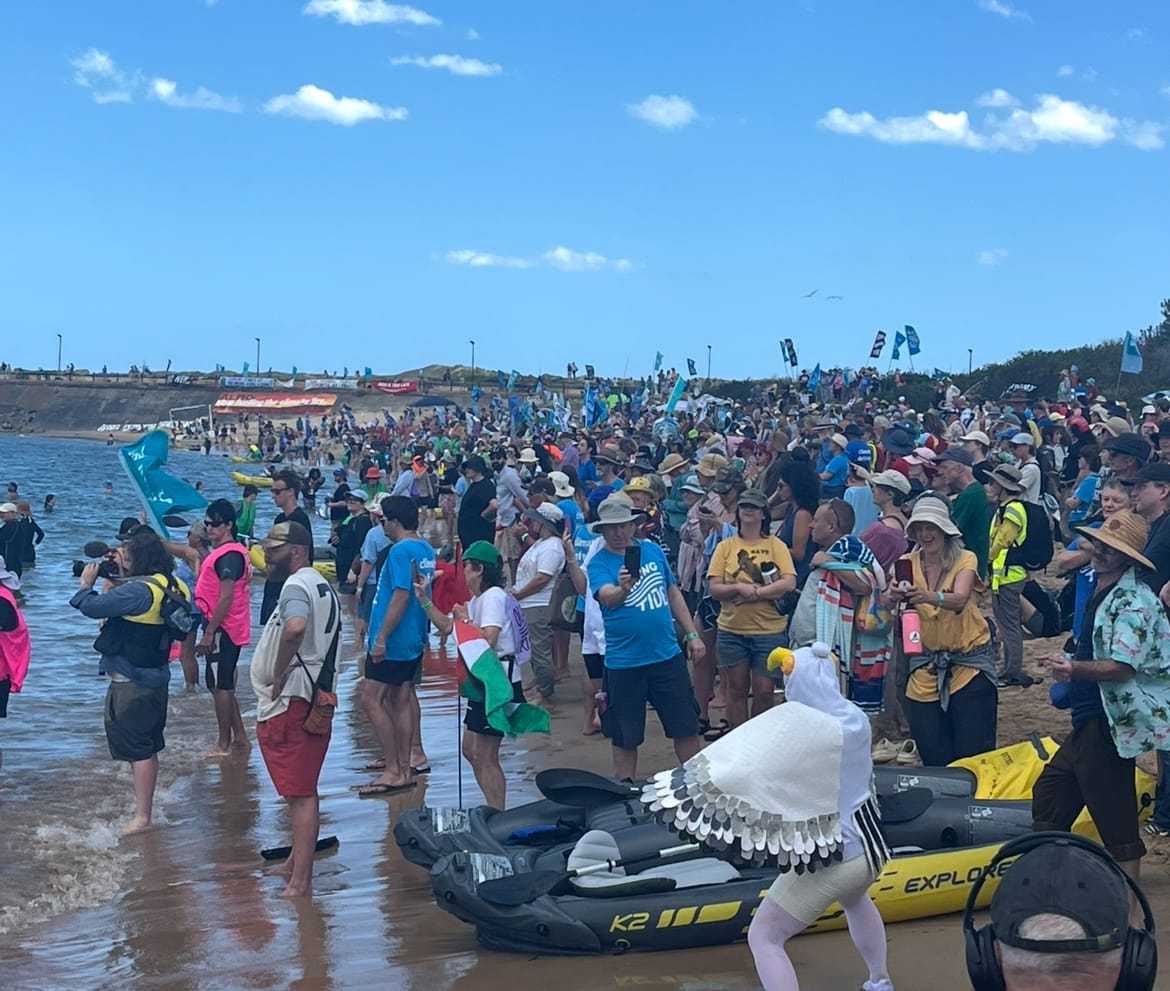
The unintentional three week hiatus in publishing here at In Between Days, and the consequent further delay in finishing the promised piece on the necessity and limits of left populism, are (largely) due to my participation in another remarkable, energising but exhausting Rising Tide blockade of the world's largest coal port in Newcastle. (Although, to be completely honest, it's also my deep tiredness, unresolved burnout, and a bunch of home front complications slowing down my initial burst of activity...) My apologies if you've been waiting, and thank you for your interest and support!
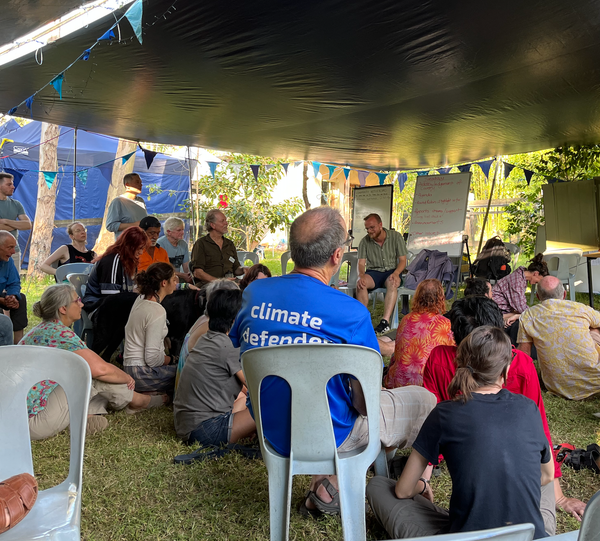
The reflections on Rising Tide here, that I decided I could write up relatively quickly in the meantime, are thoughts emerging from the two workshops that I was involved in, the Spokescouncil program that I was privileged to co-facilitate again, conversations with countless friends old and new who were there, and the broader experience of the Protestival.
Viewed, of course, from our vantage point here "between the no longer and the not yet"...
Please do send me your thoughts! I truly love the discussions with readers this blogletter is stimulating!
On extending our concept of direct action
What would it mean to truly become the rising tide?
Last year, our bold direct action turned around a coal ship entering the harbour.
Given that each of these ships carries coal that will send close to a million tonnes of CO2 into the atmosphere when burnt in power stations across the world - CO2 that global and domestic accounting doesn't attribute to Australia, but is our responsibility nevertheless - even delaying a ship by hours is an act with a measurable positive impact on global ecosystems.
This year, we did that and a lot more. We turned around a ship that had commenced entry, we directly delayed two more, forced the rescheduling of as many as ten, and effectively shut the flow of coal from world's largest coal port for the weekend.
With the collective effort of thousands of people paddling kayaks, swimming, sailing, and supporting on land in a myriad ways, we did what governments are simply unwilling (and in my opinion structurally unable) to do: we staunched the flow of death and gave us all a little more space to breathe.
That's big enough in its own right to make Rising Tide one of the most important parts of the climate movement today.
But it's so much more than that.
As I wrote last year for The Shot, alongside the big "no" to the omnicidal coal industry and the governments entwined with it, Rising Tide offers a tremendous, reverberating "yes" to the world we need. Beyond a blockade, it's a convergence, a protestival, a fabulous, fun prefiguration, a collective act of living into being the new world. I extended that thinking in a paper I delivered at the UNE Peace and Nonviolence Symposium early this year, weaving in Hannah Arendt's conception of true power arising from people coming together to "act in concert", and the extraordinary potential of that acting in concert to challenge the calcified and crumbling institutions of power that can no longer lay claim to the living power of the people.
What I want to do here is extend that thinking a little further again. I'm going to extend it in a still positive but also more critical way.
I'm going to extend it right into that abyss between the no longer and the not yet. Into that space where (as I wrote here, for those who are new at In Between Days) we know that the ground has shifted away beneath us...
But we keep acting as though it's there, papering over the cracks, as things get ever more fragile - you can't paper over an abyss. And while we're papering, we can't imagine our way to the not yet. Because the not yet isn't determined by anything other than how we choose to live - how we choose to live together and think together in this in-between.
Perhaps because that's where I feel everything at the moment, that's how I experienced Rising Tide this year: like we'd pitched our tents on paper stretched over an abyss.
Don't get me wrong - it was still fantastic and full of promise! From an actions perspective, it was a remarkable success. On various metrics, it was more successful than last year. Huge numbers of us gathered for both the no and the yes, and so many of us acted in concert, cultivating the not yet together. But the hypnotic power, the siren song, of the no longer felt oddly stronger this year than last.
It felt like the attitude of "we're doing this because government isn't" had drifted a notch towards "We're doing this to demand that government do it."
It felt like a slight drift from direct action towards protest, at a time when we need to lean in to direct action, and extend our idea of direct action ever further.
What do I mean by those terms?
The late great David Graeber sets it out here:
Well the reason anarchists like direct action is because it means refusing to recognise the legitimacy of structures of power. Or even the necessity of them. Nothing annoys forces of authority more than trying to bow out of the disciplinary game entirely and saying that we could just do things on our own. Direct action is a matter of acting as if you were already free.
The classic example is the well. There’s a town where water is monopolised and the mayor is in bed with the company that monopolises the water. If you were to protest in front of the mayor’s house, that’s protest, and if you were to blockade the mayor’s house, it’s civil disobedience, but it’s still not direct action. Direct action is when you just go and dig your own well, because that’s what people would normally do if they didn’t have water. [emphasis is mine]
Rising Tide is explicitly a civil disobedience-based movement. But it has been civil disobedience grounded in direct action: we're not blockading politicians' offices; we're blockading the coal port itself. We are taking literal direct action to stop the coal exports, because government isn't acting, so we have to act as if we truly are free to do so (and thus exposing the injustice of the anti-protest laws that purport to make us unfree).
And Rising Tide's direct action ethic goes further, of course, as I articulated last year. We take direct action to collectively feed each other and clean up after ourselves and each other. We take direct action to collectively manage the site, our security around it, and our care for each other within it. We take direct action to collectively do democracy through the spokescouncil. We do not simply trust authority to govern us, to provision us, to care for us and keep us safe - we act as if we were free to do it ourselves. We dig our own well.
This is its prefigurative power - cultivating the world we want and need from within the ashes and crumbling walls of the old world. From an Arendtian perspective, at its best, it is facing up to and resisting reality, in this abyss between the no longer and the not yet.
And... amongst the success and the increased metrics year on year... it felt a little less like facing up to and resisting of reality this year than last.
In so many of the conversations I had with people this year, there was a sense of clear resignation that government is not going to phase out the coal industry or implement a Just Transition. But at the same time there was an attitude of "well, we just have to push harder and make them do it, then".
To an extent, I feel I may be reacting to the strong focus this year on the political demand for a 78% tax on coal profits to fund the Just Transition. I absolutely understand and respect the strategic imperative behind this decision. The goal is to build a clear, positive narrative that Rising Tide supports the workers and our critique is aimed at the tax-evading, profiteering, polluting, asthma- and black lung-causing, omnicidal corporations.
Previously, the narrative has been essentially "the people vs the coal industry". We had a diverse mass of good people, colourful in kayaks, putting ourselves in front of huge coal ships that are being defended by the dark power of the state in the form of cops in black militaristic boats. The actual political demands were there, but they were secondary to the clear picture story: the state won't stop the coal, so we will.
The thing about a tax narrative is that only government can deliver on it. And we're in a historic moment when trust in government is at an all time low. And for good reason. Nobody believes government will do this. Not even us, to be brutally frank.
I tested it. Like I've done in the past, and wrote about in the last chapter of Living Democracy. I asked people, in a workshop and in conversations: "do you actually believe there's a possibility that our government will bring in a tax on coal profits at this scale? Or even a smaller one?" Nobody said yes. Nobody.
And yet (as I've observed in the synopsis section of my PhD research proposal) despite this, even as the ground of our shared world shakes and shudders and slips away, most of us seem to be clinging tighter and tighter to the status quo ante. We insist on the possibility of a faith in government's capacity to act, even as we mutter to each other that we have none.
So... what if?
What if we accepted that government won't do what we know it needs to do?
What if, liberated by this acceptance, we leant into direct action as Graeber describes it?
What if we acted "as if we were already free", "refusing to recognise the legitimacy of structures of power. Or even the necessity of them", and dug our own wells?
What if we recognised that we can't control outcomes from the top down, but we can tend to each other, and to the world around us, in ways which create space for the world we need to emerge?
What if we were to truly become the rising tide?
The thing is, all the seeds for this movement to grow are there in what's already being done!
There's been a truly wonderful focus, over the years, on building a genuinely caring culture amongst participants, and reaching into the wider community. It's why people keep coming back, and bringing friends and family, and why Rising Tide has such broad social licence in Newcastle and beyond.
There's enormous volunteer capacity, primed and ready to contribute. There were over 120 volunteer teams for this year's protestival! People want to do stuff together - out on the water stopping the coal ships, sure, but also to make the whole thing work, and to share in the vibe of creating something new together that improves our lives. And there are active and growing "hubs" in Adelaide, the Blue Mountains, Canberra, Western Sydney, the Northern Rivers and beyond.
Following feedback last year, there was a superbly orchestrated shift this year to more distributed and decentralised actions, as well as a mass action, showing how that can be more effective and disruptive to the status quo than one big showy splash.
Thanks to brilliant and beautiful training, there's a sophisticated understanding of nonviolence, of de-escalation, of consensus decision-making, of deep democracy, and there are Affinity Groups around the country - collectives of people looking out for each other and wanting to work together further - ready to form the structural basis of a tremendous, decentralised, active movement to change the world.
One of the workshops I was involved in was with the lovely crew from the Degrowth Network Australia, digging into how the direct action of stopping coal ships, and the direct action of cooking and cleaning and caring together at the camp, dovetail with the direct action of degrowth commoning in our communities. We can, through our Affinity Groups and our hubs and reaching out to people around us, weave our activism in with sharing groups and repair cafes, with local urban food systems, with community renewable energy co-ops and energy efficiency skillshares, with housing co-ops and co-housing and other RAD housing approaches, with local currencies or barter economies, with local assemblies and collective democratic decision-making...
This might seem too enormous, or spreading the movement to thin, drawing focus away from the core task of stopping coal.
But, given how many people involved in Rising Tide are already doing this kind of activity in their communities, and how many more people doing those activities might become interested in Rising Tide if we helped them see the connections, and how much of those activities work towards a world beyond coal, it's more an embrace of broader networks than a spreading too thin or a drawing of focus.
And, if we recognise that the entwined system of fossil capitalism and liberal democracy we have now simply will not do the job of stopping coal, no matter how much we demand it, as we acknowledge to each other privately, the broader pathway opens up for us to explore.
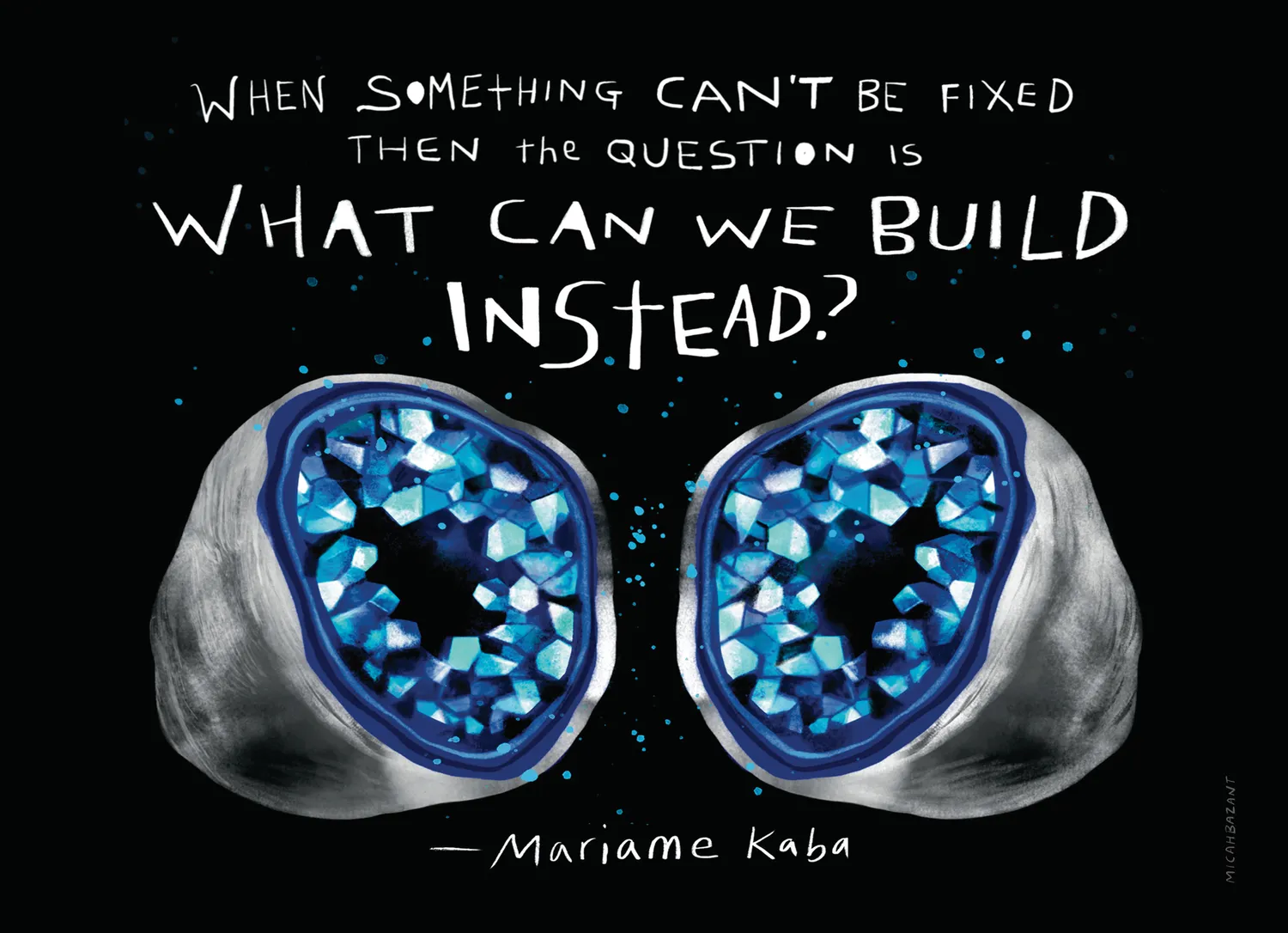
There's an incredible line I recently came across from Ruha Benjamin, Professor of Afrinca American Studies at Princeton:
“Remember to imagine and craft the worlds you cannot live without, just as you dismantle the ones you cannot live within.”
That feels, to me, like the core of our task.
To be clear, I'm not arguing for Rising Tide to drop its political demands, or in any way to stop targeting the export coal industry! I'm saying, what if the demands were framed in terms of "governments aren't stopping coal, so we're doing it."?
If our governments worked for people and the planet, instead of for corporate profits, they'd tax coal profits to fund a Just Transition for us all and set a clear date to close the industry. They're not doing that, so we have to do it ourselves. And guess what? That can be a lot of fun, and incredibly rewarding!
If we embody this approach, and embed this thinking into our strategising and action as a movement, we can truly become the Rising Tide.
NB: If you've been forwarded this by email, or found it online, please subscribe to make sure you get the next one in your inbox! And please pass this on to others who might find it interesting. I write because it helps me think things through, but it's good to know people are reading it and finding it useful.