
Abolishing collaboration?! Can we discuss that?

On practising "soft skills" for a hard future
Opposition education spokesperson, Julian Leeser, has apparently decided that the most important issue to weigh into on tertiary education right now is abolishing group assignments.*
Funnily enough, I actually went to uni with Julian, at UNSW law school way back last century. To the best of my recollection, we never did any group assignments together, but I can't deny that there were some where I probably failed to pull my weight, or coasted along on others' hard work, while busy doing student theatre productions or engaging in ratbag activism.
While I acknowledge the frustration (and you can taste the bitter resentment lingering in Julian's tone, 30 years on) there's a particular flavour of liberal, individualist entitlement in the refusal to be held responsible for other people and their actions. Closely related to hiding from the reality of death that I wrote about the other day, it's an attempt to hide from the reality of interdependence, isn't it? We are, and always will be, responsible for each other, and have to learn to live with the consequences of each others' actions. It's a silly libertarian fantasy to pretend otherwise.
But what I really wanted to riff off today is this line:
I understand the need for employers to have graduates who can collaborate in the workplace, but these are soft skills which should not be the subject of a university assessment system.
"Soft skills"?
Spoken like a man who's never had to facilitate a meeting of activists!
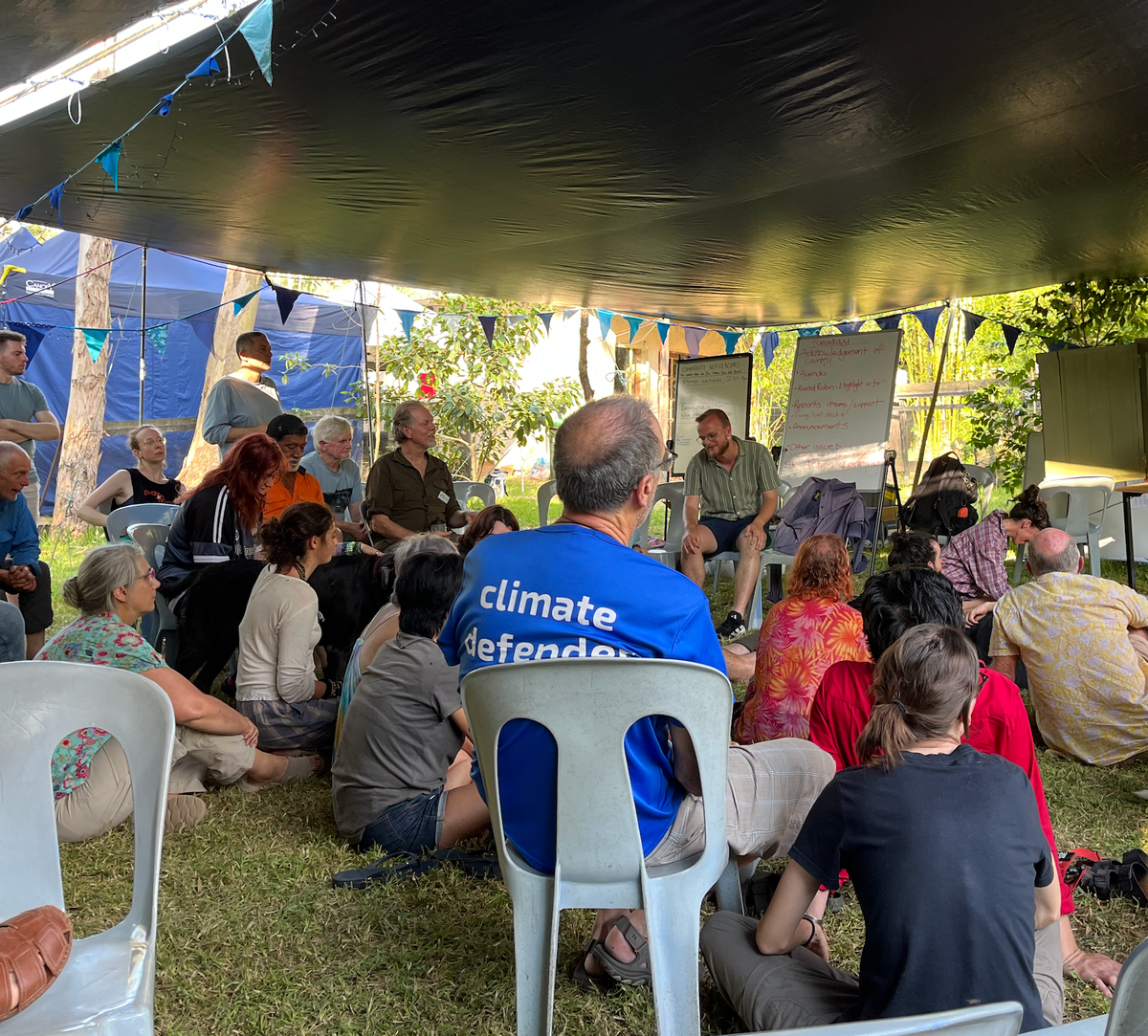
Collaboration is hard work. And the skills involved - in participating in as much as in facilitating collaboration - are technical and practical as well as cultural and emotional, and they require training and practice. As Graeme Stuart wonderfully put it at the recent Rising Tide Action Training Camp, "this isn't rocket science, it's much harder than that." And he was only half joking. It's both science and art, a high-wire act with constantly shifting and unpredictable dynamics.
To be fair to Leeser, he's not actually calling for the abolition of collaboration, only the abolition of assessment based on collaborative assignments. But let's be clear: this isn't just petty resentment at an unfair credit mark bringing down a distinction average; it's a political move to devalue and dismiss probably the most important set of skills any of us can learn.
Why do I say that?
Are you ready, kids? It's time to play "Let's ask Hannah Arendt!"
In her extraordinary 1969 essay, On Violence, Arendt does this beautiful move, inverting Mao's claim that "power comes from the barrel of a gun". The only thing that comes from the barrel of a gun, she says, is obedience, and that is a very fragile form of power - a form of power, indeed, which destroys itself, by stimulating disobedience. True power, she says, comes from acting in concert (see one of my explorations of that concept here).
Collaboration, in other words, is how we cultivate power. More than that, it's the only way of maintaining power. This is one of my favourite of her claims:
All political institutions are manifestations and materializations of power; they petrify and decay as soon as the living power of the people ceases to uphold them.
We desperately need skills in collaboration, because that is how we make any institution work. The reason our parliaments and public service and media and political parties and civil society organisations and corporations and community services and need I go on are all in varying states of dysfunction is because most of us have never been taught or sought to learn the critical skills of collaboration and most of these spaces have no decent structures for or cultures of collaboration.
This is always important. But here, as Arendt argued, in this chasm between the no longer and the not yet, when the ground has fallen away below us and we've lost a shared reality, our most important task is to think together! Thinking on your own will only get you so far at any time, but when we're already missing a common grounding, it doesn't actually get us anywhere.
Indeed, as I plan to explore at greater length soon, Arendt establishes freedom itself as a collective act! This is such a magnificent "screw you" to the American-style libertarian freedom discourse that was growing when she was writing and is at the heart of Leeser's comment that it makes me giggle. Sovereignty - of the individual or the state - is antithetical to freedom, because it rests on coercion, on violence. She calls it an illusory form of freedom. The only true freedom is in collaborative action, where we voluntarily participate, seeking our own path through and with the group.
It reminds me of Garret Hardin's Tragedy of the Commons, written in 1968. Hardin (a white supremacist who never actually did research on the management of the commons and just wrote from his narrow and prejudiced experience) claimed that commons can't be managed effectively, and private ownership is necessary to manage lands and waters. But his argument is based on the idea that people cannot and will not cooperate, cannot and will not communicate, can only blindly and deafly compete.
The erasure of collaboration is core to the capitalist project. And look where it's gotten us. Right into a polycrisis.
Collaboration isn't a "soft skill" that "employers"** might want so their workers won't fight too much and will do what they're told.
It's a complex set of skills for a hard world where the task of managing competing interests and desires is only going to get harder as various gobs of shit hit all sorts of fans. It's the core practice for the world that's coming - a world where the only way we can live is by living together.
* I guess we should be grateful that he's taking a break from trying to stamp out criticism of Israel from university campuses...
** The embedded assumption here that universities are about training good little worker-bees for employers also just needs to be pointed out. Argh. Perhaps universities could ditch all individual assessments and train students to collaborate in everything they do, including across disciplines?